Trolling Motors
Which saltwater trolling motor should you buy?
Quick answer
The Minn Kota Riptide Terrova 80 is the buy-once saltwater bow motor: 80 lb of 24 volt thrust with sealed hardware and a sacrificial anode built for salt and brackish water. A freshwater motor in salt water will corrode within a season or two.
Salt water is far harder on a trolling motor than fresh water, and the difference is not cosmetic. Salt accelerates corrosion of aluminum housings, steel fasteners and electrical contacts fast enough that a genuine freshwater motor run regularly in salt or brackish water can seize or fail within a season or two. A true saltwater motor uses grit-blasted and coated aluminum housings, stainless hardware and a sacrificial anode specifically to survive that environment, and none of it is visible in a photo on a listing page.
Thrust and voltage sizing works exactly the same way on a saltwater motor as on a freshwater one. What changes is everything about the metal, the seals and the maintenance routine, which is the part most buyers underweight until the first winterization reveals a corroded connector.
We compared published corrosion protection features, thrust and voltage against each listing and read verified owner reviews for how these motors hold up after multiple seasons in salt, rather than soaking every motor here in our own dock water.
On this page
- What actually makes a trolling motor saltwater rated?
- Thrust and voltage in saltwater
- Rinsing, anodes and winterizing in salt
- Beginner: saltwater rated without saltwater pricing
- Intermediate: more thrust for a bay boat
- Expert: full thrust and full corrosion protection
- How we chose these saltwater motors
What actually makes a trolling motor saltwater rated?
Three things, and a name on the box is not one of them. A genuine saltwater motor uses grit-blasted aluminum housings finished with a powder coat layer rather than bare metal, stainless steel fasteners and hardware in place of plated steel, and a sacrificial zinc anode designed to corrode in place of the motor's own metal. Riptide, the saltwater line from Minn Kota, and Newport's saltwater rated NV-Series motors both build these features in from the factory rather than adding a coating to a freshwater design after the fact.
Thrust and voltage in saltwater
The voltage ladder does not change in salt water: 12 volts still tops out around 55 lb of thrust, 24 volts covers 70 and 80 lb, and 36 volts starts at 101 lb. What does change is that a saltwater bay boat or flats boat is often lighter and more wind affected than an equivalent freshwater bass boat, so the 5 lb per hundred pounds figure for wind and current applies more often here than the calm water figure does.
An 80 lb saltwater bow motor runs at 24 volts on two batteries, drawing up to 56 amps at full thrust.
Published figure A published engineering, regulatory or manufacturer figure. It does not change because somebody disagrees with it.
| Thrust (lb) | System voltage | Batteries | Published max draw |
|---|---|---|---|
| 45 | 12V | 1 | 42A |
| 55 | 12V | 1 | 50A |
| 70 | 24V | 2 | 42A |
| 80 | 24V | 2 | 56A |
| 112 | 36V | 3 | 52A |
Maximum draw is the manufacturer own published figure at full thrust and sizes the breaker and cable exactly as it does on a freshwater motor.
Rinsing, anodes and winterizing in salt
Rinse the motor with fresh water after every trip in salt, not just before storage, running it briefly in a bucket or with a hose over the lower unit to flush salt out of the housing seams before it dries and crystallizes. Inspect the sacrificial anode at least once a season and replace it once it has visibly wasted away, since its entire job is to corrode instead of the motor's own aluminum, and a spent anode stops protecting anything. See the winterizing guide for the full seasonal routine on electronics as well as the motor itself.
Beginner: saltwater rated without saltwater pricing
A first saltwater motor does not have to cost premium brand money to genuinely survive salt water, provided the corrosion protection is real rather than cosmetic.

Minn Kota Riptide transom mount 45 saltwater, 36 inch shaft
$329.00 Published specsA saltwater transom motor with a telescoping tiller, the cheapest genuinely salt rated motor in this catalog.
Check price on Amazon
Newport NV-Series 36 lb thrust, 30 inch shaft
$169.99 Published specsSaltwater rated at a freshwater price, with a battery meter on the head, a common first motor on a skiff or inflatable that sees occasional salt.
Check price on AmazonIntermediate: more thrust for a bay boat
A bay boat or flats boat with real wind exposure benefits from the extra thrust and voltage step that a dedicated saltwater bow motor brings.

Minn Kota Riptide PowerDrive 70 saltwater, 54 inch shaft
$1,961.48 Published specsSeventy pounds of saltwater thrust on 24 volts with a wireless remote, without paying Terrova level money.
Check price on Amazon
Minn Kota Riptide Terrova 55 saltwater, 60 inch shaft
$2,535.82 Published specsA 12 volt saltwater bow motor with Spot-Lock, for a bay boat small enough not to need 24 volts.
Check price on AmazonExpert: full thrust and full corrosion protection
The largest saltwater motors in this catalog exist for heavier bay boats and boats that live in salt water full time rather than visiting it occasionally.

Minn Kota Riptide Terrova 80 saltwater, 60 inch shaft
$2,699.99 Published specsEighty pounds of thrust on 24 volts with the sacrificial anode and sealed hardware that decide whether a bow motor survives its second season in salt.
Best for: Any boat that touches salt or brackish water
Check price on Amazon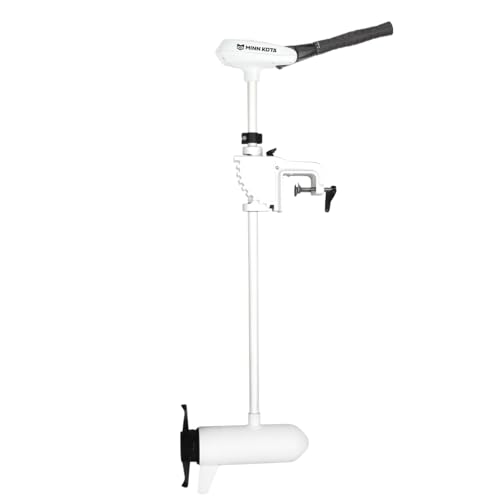
Minn Kota Riptide transom mount 112 saltwater
$1,266.97 Published specsA 36 volt transom motor rated for salt water, full bow motor level thrust on a boat with no bow to mount one on.
Check price on AmazonWho should not buy this tier: Any boat under about 3,000 lb loaded, or one that only sees salt water a handful of times a year. The full Riptide Terrova and the 36 volt Riptide transom motor both add cost and battery weight that a smaller, less frequently salted boat does not need.
How we chose these saltwater motors
We compared published corrosion protection features, thrust, voltage and maximum draw against each listing, and read verified owner reviews specifically for how each motor held up after multiple seasons in salt or brackish water. This is research based on published specifications and verified owner reviews, not our own boat soaked in dock water for a season.
How we chose
We did not test this equipment in person and we never claim to. Picks are researched from manufacturer specification sheets, published engineering and regulatory figures, and the recurring themes in verified owner reviews. Every pick is matched to a real thrust rating, a real published amp draw, a real capacity or a real conductor size rather than to a price bracket, and it is placed in the tier where its published capability actually belongs. We rejected the unbranded flood that dominates several of these search results, because a lithium pack whose management board is the only thing between a cell fault and a fire, a breaker protecting a battery cable, a life jacket and a bracket holding a two thousand dollar motor to the bow at highway speed are all parts whose failure has a consequence nobody can walk away from. Where a figure is convention rather than a published standard we label it that way, and where a manufacturer does not publish a figure we leave it out instead of estimating it.
Frequently asked questions
Can I run a freshwater trolling motor in salt water occasionally?
You can, but rinsing it thoroughly with fresh water immediately after every exposure matters far more than it does with a genuine saltwater motor, since a freshwater motor lacks the sealed hardware and sacrificial anode built into saltwater rated lines. Occasional light exposure followed by a careful rinse is a reasonable compromise for a boat that mostly stays in fresh water. Regular use in salt or brackish water calls for a genuinely saltwater rated motor instead.
How often should I replace the anode on a saltwater trolling motor?
Inspect it at least once a season and replace it once it has visibly wasted down, rather than waiting for it to disappear entirely. The anode's whole job is to corrode in place of the motor's own aluminum housing, so a spent anode leaves the motor itself exposed to the same corrosion the anode was absorbing. Heavy use in salt water can wear an anode down faster than a single season, so check it more often on a boat that runs in salt constantly.
Does a saltwater motor cost significantly more than the same thrust in freshwater?
Yes, often by several hundred dollars at the same thrust rating, because grit-blasted coated housings, stainless hardware and a sacrificial anode all add real manufacturing cost over a standard freshwater build. Budget brands like Newport Vessels narrow that gap considerably, selling saltwater rated motors closer to freshwater pricing, though typically without the parts network and multi-year warranty a premium brand like Minn Kota's Riptide line includes.
Do I need to rinse a saltwater motor even though it is built for salt?
Yes. Saltwater rating means the motor is built to resist corrosion, not that it is immune to it, and salt left to dry and crystallize in housing seams and electrical contacts will corrode even sealed hardware over time. Rinsing with fresh water after every trip flushes salt out before it has a chance to dry, and it is the single habit that most extends a saltwater motor's working life beyond its warranty period.
Is 24 volts enough for most bay boats, or do I need 36?
Most bay and flats boats under roughly 2,500 to 3,000 lb loaded do well on a 24 volt motor at 70 to 80 lb of thrust, which is the same range that covers an equivalent freshwater bass boat. Step up to 36 volts and 101 lb or more mainly for heavier boats, or water with consistently strong wind and current where the extra thrust holds position that 24 volts cannot. Run your own loaded weight through the trolling motor thrust calculator before assuming you need the larger tier.
Can I use the same battery bank for a saltwater motor and other electronics?
The motor should have its own dedicated bank sized to its published maximum draw, separate from house or cranking batteries, so a long day of trolling does not leave the boat unable to start or run navigation lights. Onboard chargers with multiple isolated banks let you charge a trolling motor bank and a separate house bank from a single unit without them interacting, which is the usual setup on a bay boat running both.
Get the complete rigging shopping list
Every item in the beginner, intermediate and expert rigs for both a boat and a kayak, with running totals, in one printable list. No charge.
One list, no sequence of daily emails, and you can leave at any time.
Researched, not professional advice. This page is compiled from published engineering and regulatory figures, manufacturer specifications and owner-review consensus, not hands-on testing. Figures described as a rule of thumb are boating convention rather than published standards, and they are labelled that way wherever they appear. Marine electrical work is not house wiring. Use tinned, finely stranded marine cable, size it for voltage drop and for the ABYC E-11 ampacity table rather than one or the other, and put overcurrent protection within seven inches of the battery positive terminal, because everything between the post and the fuse is unprotected. A lithium battery needs a charger with a lithium profile. Never load a boat past its capacity plate, and remember that canoes and kayaks carry no federal capacity plate at all, so their stated capacity is the manufacturer own figure. Wear the life jacket, and treat early season water as the hazard it is: cold water immersion takes your breath and then your hands long before it takes your core.