Batteries and run time
Trolling motor run time calculator
Quick answer
A 100 Ah AGM battery holds a 50 amp draw for roughly 1.5 hours, not the two hours simple division suggests. The same nameplate in LiFePO4 gives about 3.2 hours, because lithium is barely affected by discharge rate and is planned to eighty percent rather than fifty.
Dividing amp hours by amps gives an answer that is wrong for every chemistry here, and badly wrong for lead acid. Two separate effects cut it down and they apply in order.
Peukert comes first. A battery printed capacity is measured discharging it over 20 hours, and pulling it faster returns less. Depth of discharge comes second: lead acid is conventionally taken to half its capacity to protect cycle life, so half the rating was never on the table. Lithium is close to immune to the first and is planned at eighty percent on the second, which is most of why it costs three times as much.
Run your own numbers
A 100 Ah AGM holds 50 amps for about 0.7 hours. The same nameplate in LiFePO4 gives about 1.5 hours.
| Figure | Value |
|---|---|
| Simple division (wrong) | 2.0 h |
| Delivered at this draw, AGM | 71 Ah |
| Usable to 50 percent, AGM | 35 Ah |
| Flooded lead acid run time | 0.6 h |
| AGM lead acid run time | 0.7 h |
| Gel lead acid run time | 0.6 h |
| LiFePO4 lithium run time | 1.5 h |
Shown with the example figures above. Change any field to run your own numbers.
The working
Published figurePeukert first: t = H x ( C / ( I x H ) ) ^ k H = 20 hours then depth of discharge: run time = t x DoD k = 1.25 flooded, 1.15 AGM, 1.20 gel, 1.02 LiFePO4 DoD = 0.50 lead acid, 0.80 LiFePO4
Peukert equation and the twenty hour rating basis are published battery engineering. The depth of discharge multiplier is convention on lead acid and manufacturer guidance on lithium. A published engineering, regulatory or manufacturer figure. It does not change because somebody disagrees with it.
Batteries at or above this capacity
Ranked by published capacity against the figure you entered. Capacity, chemistry and group size are all manufacturer figures, and a battery weight is a per product specification rather than a general rule.

LiTime 12V 100Ah Group 24 LiFePO4 battery
$365.99 Published specsGroup 24 case, which matters because it drops into an existing battery tray without rebuilding the compartment.
Check price on Amazon
LiTime 12V 100Ah trolling motor LiFePO4 battery for marine and yacht
$355.99 Published specsThe same capacity in the marine housing, and the usual alternative listing when the other is out of stock.
Check price on Amazon
LiTime 12V 100Ah Xtra Mini LiFePO4 battery
$338.39 Published specsA physically smaller 100 Ah pack, which is the whole argument for lithium on a kayak where the compartment is the constraint.
Best for: Kayaks and small boats where the battery box space is fixed
Check price on Amazon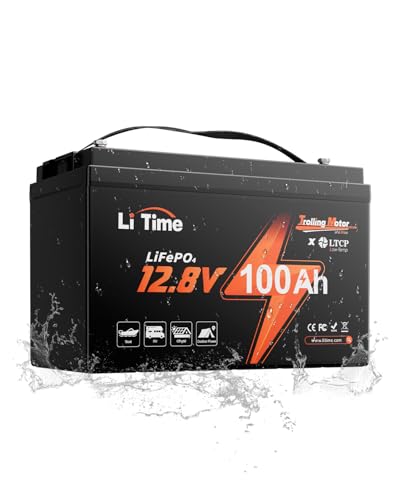
LiTime 12V 100Ah trolling motor LiFePO4 battery
$335.99 Published specsBuilt for the trolling motor case specifically, which mainly means a BMS sized to sustain the high continuous discharge a motor asks for.
Best for: A 55 lb thrust 12 volt motor on a boat that fishes full days
Check price on Amazon
LiTime 12V 100Ah Group 27 LiFePO4 battery
$320.39 Published specsThe Group 27 case for boats whose trays were built around lead acid of that size.
Check price on Amazon
VMAX XTR27-110 12V 110Ah AGM Group 27 battery
$299.96 Published specsThe high performance VMAX line, built for deeper and more frequent cycling than the standard MR series.
Check price on AmazonEvery figure shown is the manufacturer own published specification. The rating on the unit you receive is what governs, and the capacity plate on your own boat governs everything above it.
The two effects, separately
LiFePO4 sits at a Peukert exponent near 1.02, which is effectively no penalty at all, against 1.15 for AGM and 1.25 for flooded.
Published figure A published engineering, regulatory or manufacturer figure. It does not change because somebody disagrees with it.
| Chemistry | Peukert exponent | Depth of discharge used | What that means at a heavy draw |
|---|---|---|---|
| Flooded lead acid | 1.25 | 50% | Gives up the most capacity of any chemistry here at high current |
| AGM lead acid | 1.15 | 50% | Gives up a real fraction of its rating at trolling motor currents |
| Gel lead acid | 1.2 | 50% | Gives up a real fraction of its rating at trolling motor currents |
| LiFePO4 lithium | 1.02 | 80% | Delivers close to its rating at any draw |
Peukert equation and the twenty hour rating basis are published battery engineering. The depth of discharge figures are convention on lead acid and manufacturer guidance on lithium, and this site labels them differently for that reason.
What a fishing day actually draws
The figure this calculator takes is a continuous draw, and almost nobody produces one. A published maximum draw happens at maximum thrust, and a day of fishing is mostly low settings with occasional bursts, which is why a motor that would flatten a battery in ninety minutes at full power happily fishes all day.
The honest input is your own average draw, measured with a clamp meter on the motor positive cable across a normal day. No manufacturer publishes a current draw table by speed setting, so any per-speed figure you find anywhere, including our own modelled one, is an estimate rather than a specification.
Why lithium changes the arithmetic twice
It is worth separating the two effects because people credit lithium with one and get the size of the win wrong.
First, a LiFePO4 pack delivers essentially its rated capacity even at a fifty amp draw, where an AGM gives up a real fraction of it. Second, it is planned at eighty percent depth of discharge rather than fifty. Those multiply rather than add, which is why the same nameplate roughly doubles the useful run time rather than improving it by a third.
Against that: it costs about three times as much, and if you already finish a normal day with plenty left in an AGM, the extra capacity is money spent on a margin you never touch.
Frequently asked questions
How long will a 100 Ah battery run a trolling motor?
At a 50 amp draw, about 1.5 hours in AGM and about 3.2 hours in LiFePO4, taking each to its recommended depth of discharge. Simple division gives two hours and is wrong for both, because it ignores the Peukert effect at high discharge rates and ignores the fact that half a lead acid battery was never available to begin with.
What is the Peukert effect?
It describes how a battery delivers less than its rated capacity when discharged faster than the twenty hour rate the rating is measured at. The exponent is chemistry dependent: around 1.25 for flooded lead acid, 1.15 for AGM and close to 1.02 for LiFePO4. It is published battery engineering rather than a rule of thumb.
Why only use half of a lead acid battery?
To protect cycle life rather than because the battery stops there. Repeatedly taking a deep cycle lead acid battery to twenty percent shortens its life dramatically, so fifty percent is the working guideline. It is convention rather than a published limit, and the manufacturer cycle life curve for your specific battery is a better guide than any general figure.
Should I use the published maximum draw?
Only if you genuinely run the motor flat out all day, which almost nobody does. A published maximum draw is measured at maximum thrust. Measuring your own average draw with a clamp meter across a normal fishing day usually shows a figure well under half the rating, and planning from that gives you the day you actually fish.
Does cold water change the run time?
Considerably, and in both chemistries. Lead acid capacity falls noticeably in the cold, which is exactly when early season anglers are out. LiFePO4 holds capacity better but must not be charged below freezing without a management board that handles it, which is why low temperature protection appears in the specifications of the better packs.
Do two batteries in parallel double the run time?
Close to it, and slightly better than double on lead acid, because the pair is discharged at a gentler rate relative to its combined capacity so the Peukert penalty falls. Never parallel a new battery with an old one or two different chemistries: the pair equalises through the interconnect and the weaker one drags the stronger one down.
Get the complete rigging shopping list
Every item in the beginner, intermediate and expert rigs for both a boat and a kayak, with running totals, in one printable list. No charge.
One list, no sequence of daily emails, and you can leave at any time.
Researched, not professional advice. This page is compiled from published engineering and regulatory figures, manufacturer specifications and owner-review consensus, not hands-on testing. Figures described as a rule of thumb are boating convention rather than published standards, and they are labelled that way wherever they appear. Marine electrical work is not house wiring. Use tinned, finely stranded marine cable, size it for voltage drop and for the ABYC E-11 ampacity table rather than one or the other, and put overcurrent protection within seven inches of the battery positive terminal, because everything between the post and the fuse is unprotected. A lithium battery needs a charger with a lithium profile. Never load a boat past its capacity plate, and remember that canoes and kayaks carry no federal capacity plate at all, so their stated capacity is the manufacturer own figure. Wear the life jacket, and treat early season water as the hazard it is: cold water immersion takes your breath and then your hands long before it takes your core.