Batteries and charging
Onboard charger sizing calculator
Quick answer
A 100 Ah bank wants about 13 amps per bank on lead acid, which rounds up to a stocked 15 amp output, and puts back a half discharged battery in roughly 5 hours. The figure that matters more than the amps: a lithium pack needs a charger with a lithium profile.
An onboard charger has one output per battery, and the number that matters is the output per bank rather than the total printed on the box. A three bank ten amp charger is ten amps per battery and thirty amps in total, and manufacturers frequently market the total. Quoting the total against the whole bank is how people end up undercharging by a factor of three.
Count the banks first: one per battery, plus one more if you want the charger to look after the cranking battery too. A 36 volt motor on three 12 volt batteries plus a starter is a four bank charger. A single 36 volt lithium pack needs a 36 volt charger instead, which is a genuinely different product.
Size your own charger
A 100 Ah bank across 2 banks wants about 15 amps per bank, and puts back a normal day in roughly 3.8 hours.
| Figure | Value |
|---|---|
| Typical rate for this chemistry | 13.0 A per bank |
| Nearest stocked output | 15 A per bank |
| Banks needed | 2 |
| Total charger output | 30 A |
| Amp hours to put back | 50 Ah |
| Recharge time | 3.8 h |
| If this were LiFePO4 | 20 A per bank |
Shown with the example figures above. Change any field to run your own numbers.
The working
Rule of thumboutput per bank = bank capacity x charge rate charge rate = 0.13 lead acid (convention, ceiling about 0.25) = 0.20 LiFePO4 (maker guidance, up to about 0.50) recharge hours = ( amp hours used x charge efficiency ) / amps per bank
The lead acid percentage is convention. Charge efficiency is published battery engineering, at about 1.15 for AGM and 1.03 for LiFePO4. Boating and fishing convention rather than a published standard. Taught everywhere, useful, and not a specification. Nothing enforces it and no body publishes it.
Chargers with enough banks
Bank count and output per bank are both manufacturer figures. If any battery on the boat is lithium, check that the charger states a lithium profile before anything else.
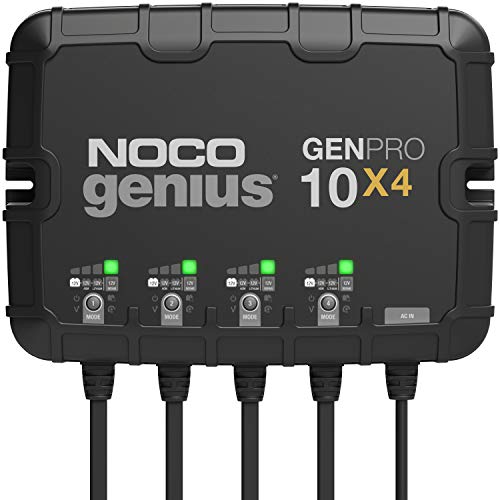
NOCO GENPRO10X4 12V 40A 4-bank onboard charger
$424.95 Published specsFour banks: three for a 36 volt motor and one for the cranking battery, which is the usual full boat configuration.
Check price on Amazon
Minn Kota MK-440PCL onboard charger, 4 banks 10 amps
$389.99 Published specsFour banks with a lithium profile, for a 36 volt lithium motor bank plus a lead acid cranking battery on the same charger.
Check price on Amazon
Dual Pro Sportsman Series 3-bank charger, 10 amps per bank
$388.30The three bank version, which is the standard fit behind a 36 volt motor on a serious boat.
Check price on Amazon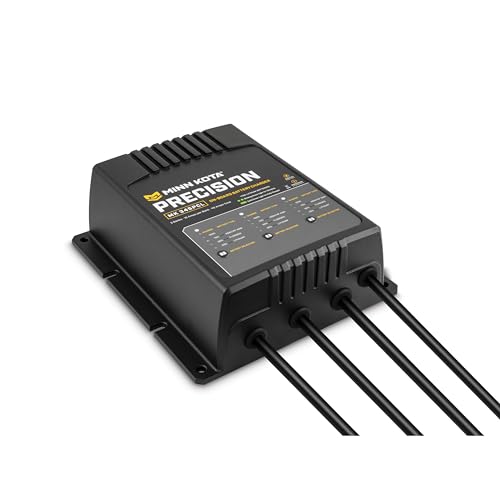
Minn Kota MK-345PCL onboard charger, 3 banks 15 amps
$372.02 Published specsFifteen amps per bank with a lithium profile, which is the fastest genuine three bank charge here.
Check price on Amazon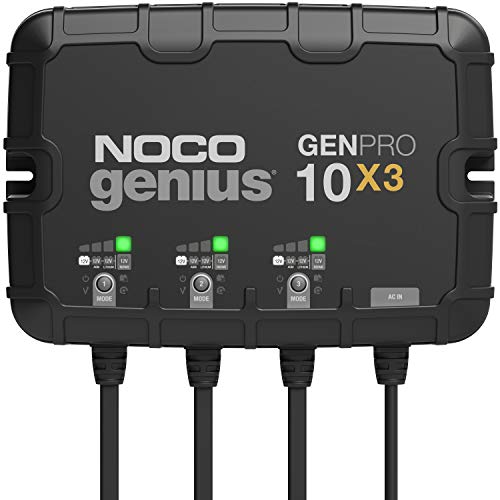
NOCO GENPRO10X3 12V 30A 3-bank onboard charger
$324.95 Published specsThirty amps across three banks, which is the size a 36 volt lithium bank wants if it is going back out the next morning.
Check price on Amazon
Dual Pro Sportsman Series 2-bank charger, 10 amps per bank
$319.48Dual Pro chargers are built in the United States and are what most tournament boats end up with after killing something cheaper.
Check price on AmazonEvery figure shown is the manufacturer own published specification. The rating on the unit you receive is what governs, and the capacity plate on your own boat governs everything above it.
Charge rate by chemistry
Lead acid wants roughly ten to thirteen percent of bank capacity and has a real ceiling around a quarter. Lithium will take up to about half its capacity.
Rule of thumb Boating and fishing convention rather than a published standard. Taught everywhere, useful, and not a specification. Nothing enforces it and no body publishes it.
| Chemistry | Minimum rate | Typical rate | Maximum accepted | Charge efficiency |
|---|---|---|---|---|
| Flooded lead acid | 10% of capacity | 13% of capacity | 25% of capacity | 1.2 Ah in per Ah out |
| AGM lead acid | 10% of capacity | 13% of capacity | 30% of capacity | 1.15 Ah in per Ah out |
| Gel lead acid | 10% of capacity | 12% of capacity | 20% of capacity | 1.18 Ah in per Ah out |
| LiFePO4 lithium | 10% of capacity | 20% of capacity | 50% of capacity | 1.03 Ah in per Ah out |
The ten to thirteen percent lead acid figure is convention rather than a published standard. The lithium figures are manufacturer guidance and vary between packs, so check the specification for your own battery. Charge efficiency is published battery engineering.
The thing that matters more than the amps
A lithium battery needs a charger with a lithium profile. This is not about speed and it is not a preference.
A lead acid charge profile ends with an absorption and float stage at a voltage LiFePO4 should not sit at, and some lead acid chargers never reach the bulk voltage a lithium pack needs at all, so the pack sits permanently part charged. Neither failure announces itself: the battery simply underperforms or ages badly and people blame the battery.
On a mixed boat, where the motor bank is lithium and the cranking battery is still lead acid, you need a charger that sets its profile per bank rather than one profile for the whole unit.
Why a bigger charger does not always help
Lead acid has a genuine ceiling on charge acceptance, around a quarter of its capacity, and pushing past it produces heat and gassing rather than a faster charge. It also slows dramatically in the final absorption stage: getting a lead acid battery from empty to eighty percent is quick, and the last twenty percent is slow regardless of charger size.
That means the recharge times this calculator reports are optimistic for lead acid and close to honest for lithium, which is worth knowing before you buy a large charger expecting it to fix an overnight problem.
Frequently asked questions
What size onboard charger do I need?
Roughly ten to thirteen percent of each battery capacity, per bank. A 100 Ah bank wants about 13 amps per bank, which rounds up to a stocked 15 amp output. A LiFePO4 pack of the same capacity will take considerably more, commonly up to half its capacity, though twenty percent is a comfortable onboard figure that does not need a large unit.
Is the charger rating per bank or in total?
Per bank, and this trips people up constantly. A three bank ten amp charger delivers ten amps to each of three batteries, thirty amps in total. Manufacturers frequently market the total figure, so a charger sold as thirty amps may be ten per bank. Size the per bank figure against one battery capacity, never the total against the whole bank.
Can a lead acid charger charge a lithium battery?
Not safely and often not fully. A lead acid profile ends in an absorption and float stage at a voltage a LiFePO4 pack should not be held at, and many lead acid chargers never reach the bulk voltage lithium needs, so the pack sits permanently part charged. A charger with a lithium profile is a requirement rather than an upgrade, and chargers that have one say so.
How many banks do I need?
One per battery, plus one more if the charger should also maintain the cranking battery. A 12 volt motor on one battery plus a starter is two banks. A 24 volt motor is two banks plus the starter makes three. A 36 volt motor on three batteries plus a starter is the common four bank setup. A single 36 volt lithium pack needs a 36 volt charger instead.
Do I need a bank for the starting battery?
It is worth having. An outboard alternator charges the cranking battery while you run, but a day of electronics with the engine off leaves it untouched, and a starting battery that has been sitting is the classic reason a boat will not start at the end of a good day. The extra bank costs less than a tow.
Onboard charger or a portable one?
An onboard charger is permanently mounted, wired to each battery and waterproof, so charging means plugging in a shore cord and nothing else. A portable charger is cheaper and means clipping leads to each battery in turn, which is fine once and tiresome weekly. Once the batteries live under a deck, the onboard unit is the only realistic option.
Get the complete rigging shopping list
Every item in the beginner, intermediate and expert rigs for both a boat and a kayak, with running totals, in one printable list. No charge.
One list, no sequence of daily emails, and you can leave at any time.
Researched, not professional advice. This page is compiled from published engineering and regulatory figures, manufacturer specifications and owner-review consensus, not hands-on testing. Figures described as a rule of thumb are boating convention rather than published standards, and they are labelled that way wherever they appear. Marine electrical work is not house wiring. Use tinned, finely stranded marine cable, size it for voltage drop and for the ABYC E-11 ampacity table rather than one or the other, and put overcurrent protection within seven inches of the battery positive terminal, because everything between the post and the fuse is unprotected. A lithium battery needs a charger with a lithium profile. Never load a boat past its capacity plate, and remember that canoes and kayaks carry no federal capacity plate at all, so their stated capacity is the manufacturer own figure. Wear the life jacket, and treat early season water as the hazard it is: cold water immersion takes your breath and then your hands long before it takes your core.