Trolling Motors
Which transom mount trolling motor should you buy?
Quick answer
The Minn Kota Endura Max 55 is the largest 12 volt transom motor worth fitting, at 55 lb of thrust on a single battery. Heavier boats step up to the 24 or 36 volt Riptide transom line rather than overloading a 12 volt motor.
A transom mount motor clamps directly to the back of the hull and is steered by hand with a tiller, which makes it far cheaper than a bow mount motor at any given thrust rating and the right answer on a boat with no bow deck space to bolt a bracket to. Jon boats, canoes, small aluminum boats and inflatables are its natural home, and a transom motor is also the standard way to add auxiliary power to a boat that already runs an outboard.
The size argument on a transom motor is simpler than on a bow mount, because the choice mostly comes down to how much thrust a 12 volt single battery system can usefully carry before stepping up to 24 or 36 volts starts to make more sense than fighting a 12 volt motor that is undersized for the boat.
We compared published specifications and verified owner reviews for this roundup rather than clamping every motor here to our own transom. Manufacturer maximum draw figures and thrust ratings come directly from each listing.
On this page
- Who actually needs a transom mount motor instead of a bow mount?
- Thrust and voltage on a transom motor
- Shaft length is shorter on a transom than on a bow
- Beginner: the simplest working motor
- Intermediate: variable speed instead of fixed steps
- Expert: full thrust with no bow to mount it on
- How we chose these transom motors
Who actually needs a transom mount motor instead of a bow mount?
Anyone whose boat has no flat bow deck to bolt a bracket to. A canoe, a small jon boat, most inflatables and any small craft with a pointed or crowded bow simply cannot take a bow mount motor without adding a deck first, which is a real fabrication project rather than a bolt-on option. A transom motor also makes sense as backup auxiliary power on a larger boat that already runs an outboard, since it clamps on and off in minutes and needs no dedicated deck space at all.
Thrust and voltage on a transom motor
The same voltage ladder applies here as on any trolling motor: 12 volts on one battery covers up to about 55 lb of thrust, and beyond that the Riptide transom line steps up to 24 and eventually 36 volts. A 36 volt transom motor is an unusual and genuinely useful thing, because it puts full bow motor level thrust on a boat that simply has nowhere to mount a bow motor at all.
A 45 lb 12 volt transom motor draws up to 42 amps at full thrust, the same published figure as a 12 volt bow motor of the same size.
Published figure A published engineering, regulatory or manufacturer figure. It does not change because somebody disagrees with it.
| Thrust (lb) | System voltage | Batteries | Published max draw |
|---|---|---|---|
| 40 | 12V | 1 | 42A |
| 45 | 12V | 1 | 42A |
| 55 | 12V | 1 | 50A |
| 70 | 24V | 2 | 42A |
| 112 | 36V | 3 | 52A |
Always check the maximum draw printed on your own motor rather than assuming a class average, since draw depends on the propeller and controller as well as thrust.
Shaft length is shorter on a transom than on a bow
A transom sits much closer to the waterline than a bow deck does, so a transom motor typically needs a far shorter shaft than a bow mount motor of the same thrust, often 30 to 36 inches against 45 to 60 inches on a bow mount. Measure from the transom mounting point to the waterline with the boat loaded, add 16 inches in sheltered water or 20 inches in rough water, and round up to a stocked length exactly as on a bow motor. The trolling motor shaft length calculator handles the arithmetic either way.
Beginner: the simplest working motor
A first transom motor should be simple enough that there is nothing electronic to fail after a season of storage between trips.
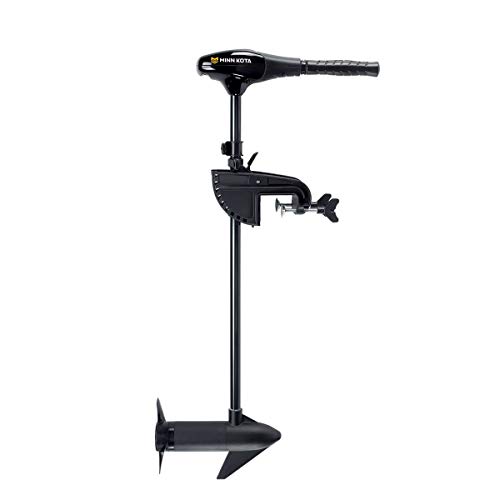
Minn Kota Endura C2 40, 36 inch shaft
$259.99 Published specsFive forward speeds and a mechanical switch, with nothing electronic to go wrong. The motor most likely to still be running in a decade.
Best for: A jon boat, canoe or small aluminum boat on one battery
Check price on Amazon
Newport NV-Series 36 lb thrust, 30 inch shaft
$169.99 Published specsSaltwater rated at a freshwater price, with a battery meter on the head, and the usual first motor on an inflatable or a canoe.
Check price on AmazonIntermediate: variable speed instead of fixed steps
Digital Maximizer variable speed control genuinely extends run time at the low settings most anglers actually troll at, rather than forcing a choice between five fixed speed steps.
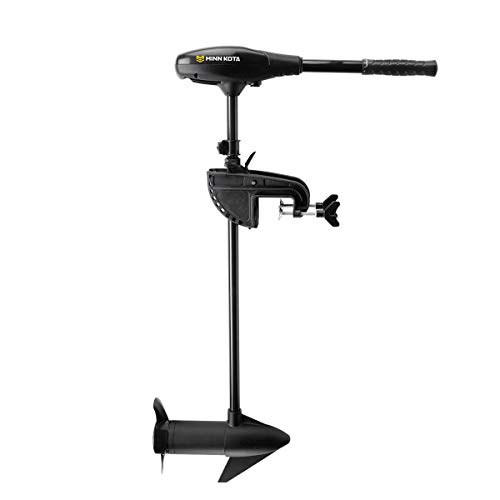
Minn Kota Endura Max 45, 36 inch shaft
$279.99 Published specsDigital Maximizer gives variable speed instead of five fixed steps, extending run time at the low settings people actually troll at.
Check price on Amazon Minn Kota Endura Max 55, 42 inch shaft
$329.99 Published specsThe largest 12 volt transom motor worth fitting, and the practical ceiling for what a single battery can usefully drive.
Check price on AmazonExpert: full thrust with no bow to mount it on
The 36 volt Riptide transom motor puts full bow-motor-level thrust on a hull with no bow deck to mount a bow motor on at all.
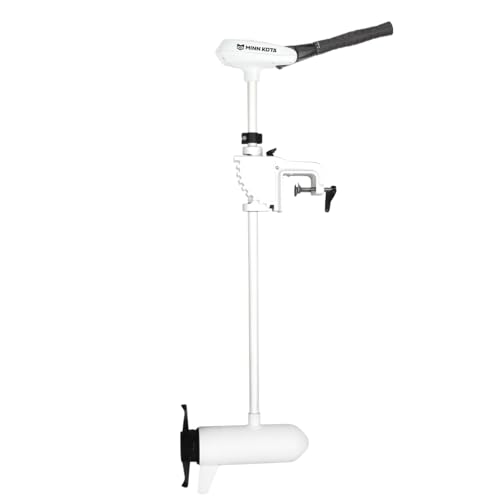
Minn Kota Riptide transom mount 112 saltwater
$1,266.97 Published specsA 36 volt transom motor, an unusual and useful thing: full bow motor thrust on a boat with no bow to mount one on.
Check price on Amazon Newport NV-Series 62 lb thrust
$299.99More thrust than any 12 volt Minn Kota in this catalog, worth knowing about for a heavy jon boat staying on a single battery.
Check price on AmazonWho should not buy this tier: Any boat small enough that a 12 volt transom motor already does the job. A 36 volt transom motor still needs three batteries wired in series, and that weight is wasted on a boat light enough to move easily on one.
How we chose these transom motors
We compared published thrust, voltage and maximum draw across the Endura, Riptide and Newport lines, checked shaft lengths against typical transom heights, and read verified owner reviews for tiller and bracket durability. This is specification comparison and published research, not an in-person trial of every motor clamped to our own transom.
How we chose
We did not test this equipment in person and we never claim to. Picks are researched from manufacturer specification sheets, published engineering and regulatory figures, and the recurring themes in verified owner reviews. Every pick is matched to a real thrust rating, a real published amp draw, a real capacity or a real conductor size rather than to a price bracket, and it is placed in the tier where its published capability actually belongs. We rejected the unbranded flood that dominates several of these search results, because a lithium pack whose management board is the only thing between a cell fault and a fire, a breaker protecting a battery cable, a life jacket and a bracket holding a two thousand dollar motor to the bow at highway speed are all parts whose failure has a consequence nobody can walk away from. Where a figure is convention rather than a published standard we label it that way, and where a manufacturer does not publish a figure we leave it out instead of estimating it.
Frequently asked questions
What size transom motor does a jon boat need?
Weigh the boat fully loaded with motor, battery, fuel, gear and everyone aboard, then plan for 2 to 3 lb of thrust per hundred pounds in normal conditions, rising to 5 lb per hundred in wind or current. A typical two person jon boat loaded to around 800 lb lands comfortably on a 40 to 55 lb 12 volt motor. Run the exact figure through the trolling motor thrust calculator rather than guessing from the boat's length alone.
Can I put a bigger transom motor on a boat instead of upgrading to a bow mount?
Up to a point. The Riptide transom line goes as high as 112 lb of thrust at 36 volts, which covers boats that would otherwise need a bow mount motor, and it avoids the cost and deck work of adding a bow bracket. The tradeoff is steering: a transom motor is tiller steered by hand from the back of the boat, which is less precise for holding a tight position than a bow motor pulling from the front with GPS anchoring.
Why is the shaft on a transom motor shorter than on a bow mount motor?
A transom sits much closer to the waterline than a bow deck does on most hulls, so the same formula, measuring down to the waterline and adding 16 or 20 inches, produces a shorter answer at the transom. A typical jon boat or canoe transom motor runs 30 to 36 inches where an equivalent bow mount motor on the same boat might need 42 to 48 inches, purely because of where each one is mounted.
Do saltwater rated transom motors cost much more than freshwater ones?
Not always. Some budget brands sell saltwater rated transom motors at close to freshwater pricing, using corrosion resistant hardware and coated housings without the premium a name brand saltwater line charges. The genuine Minn Kota Riptide transom line costs considerably more than the freshwater Endura line at the same thrust rating, so a saltwater rated motor from a budget brand is worth considering specifically for boats that only touch brackish or salt water occasionally.
Is a mechanical five speed transom motor worse than a variable speed one?
Not worse, simpler. A mechanical motor with five forward speeds has no electronics to fail and is often the more reliable choice for occasional use or long term storage between seasons. A variable speed motor with Digital Maximizer technology extends run time at low, slow trolling speeds specifically, which matters more to anglers who troll for hours at a stretch than to someone using the motor mainly to reposition between casts.
Does a transom motor need the same overcurrent protection as a bow motor?
Yes. ABYC E-11 requires overcurrent protection within 7 inches of the battery positive terminal regardless of where the motor itself is mounted, extended to 40 inches when the conductor runs inside a sheath. The rule protects the cable between the battery and the fuse, not the motor, so mount type has no bearing on whether a breaker is needed. A 40 or 45 lb transom motor still draws real current at full thrust and needs the same protection as a bow mount motor of the same size.
Get the complete rigging shopping list
Every item in the beginner, intermediate and expert rigs for both a boat and a kayak, with running totals, in one printable list. No charge.
One list, no sequence of daily emails, and you can leave at any time.
Researched, not professional advice. This page is compiled from published engineering and regulatory figures, manufacturer specifications and owner-review consensus, not hands-on testing. Figures described as a rule of thumb are boating convention rather than published standards, and they are labelled that way wherever they appear. Marine electrical work is not house wiring. Use tinned, finely stranded marine cable, size it for voltage drop and for the ABYC E-11 ampacity table rather than one or the other, and put overcurrent protection within seven inches of the battery positive terminal, because everything between the post and the fuse is unprotected. A lithium battery needs a charger with a lithium profile. Never load a boat past its capacity plate, and remember that canoes and kayaks carry no federal capacity plate at all, so their stated capacity is the manufacturer own figure. Wear the life jacket, and treat early season water as the hazard it is: cold water immersion takes your breath and then your hands long before it takes your core.