Kayak fishing
Pedal or paddle kayak: is hands-free propulsion worth the cost?
Quick answer
A pedal kayak frees both hands to fish while the boat is still moving, which a paddle kayak cannot do, but it costs roughly three times as much and weighs close to twice as much once rigged. Buy pedal for hands-free position control on open water, and paddle if budget, weight or car-topping alone matter more than that.
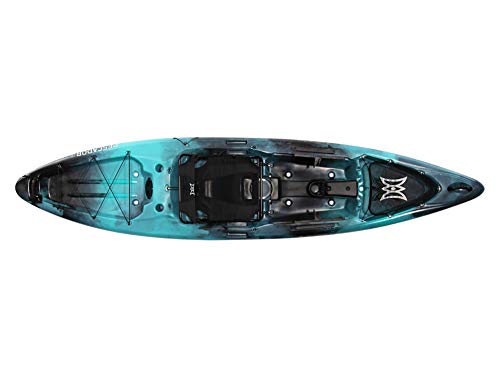
Perception Pescador Pro 12 sit-on-top fishing kayak
$999.00 Published specsA twelve foot sit-on-top hull with a lawn chair frame seat, the buy-once paddle fishing kayak
Best for: The buy-once paddle fishing kayak
Check price on Amazon
Old Town Sportsman PDL 120 pedal fishing kayak
$2,999.99A forward and reverse pedal drive that reverses instantly through the pedals themselves, on a twelve foot hull
Check price on AmazonA pedal drive is hands-free propulsion, and that single fact is the entire case for paying more. The Old Town Sportsman PDL 120 lets you hold position against wind or current, work a shoreline, or fight a fish while the boat is still moving under pedal power, none of which a paddle kayak can do without setting the paddle down first. The Perception Pescador Pro 12 gives that up entirely, needing a hand off the rod to move the boat at all, and in exchange it costs roughly a third of the pedal hull and weighs less than half as much once you account for the pedal console.
The reversible drive matters more than it sounds like on paper. The PDL drive reverses instantly through the pedals themselves, no separate lever or motor to switch, which is exactly the control you want the moment a hooked fish runs back under the hull and the boat needs to back off fast. A paddle kayak handles the same moment by dropping the rod, grabbing the paddle, and backpaddling by hand, which works but is slower and needs a free hand that a fighting fish does not always allow.
None of that makes a pedal kayak the better boat for every angler. The cost and weight gap is real and it shows up hardest at the car-topping stage, well before the boat ever touches water.
On this page
What hands-free propulsion actually buys you
A pedal drive turns a kayak into a boat you steer and move with your legs while your hands stay on a rod, which changes how you fish rather than just how you get around. Working a shoreline at a controlled pace, holding position in light current without paddling, and repositioning after a cast are all things a pedal kayak does without interrupting the retrieve. A paddle kayak like the Pescador Pro 12 does none of this while the paddle is down, and every repositioning move costs a moment of not fishing to pick the paddle back up.
What each one actually costs
The pedal PDL 120 lists at roughly $3,000 against about $1,000 for the paddle Pescador Pro 12, close to a three times price gap for the same twelve foot hull length.
Published figure A published engineering, regulatory or manufacturer figure. It does not change because somebody disagrees with it.
| Kayak | Drive | Length | Price |
|---|---|---|---|
| Pescador Pro 12 | Paddle | 12 ft | $999.00 |
| PDL 120 | Pedal | 12 ft | $2,999.99 |
Prices are the catalog listing at the time this page was written and move with the market. Neither figure includes a paddle, PFD, sonar or the battery a pedal drive's electronics may need.
Weight and why it matters at the car, not on the water
The Pescador Pro 12 weighs a published 64 lb, while the PDL 120's hull weighs a published 116 lb with an additional 19 lb removable pedal console, close to 135 lb total once the drive is installed. Neither hull feels heavy once it is floating, but getting either one onto a roof rack alone is a different problem entirely, and the pedal hull's extra 70 lb or so is exactly the weight that turns a solo car-top load into a two-person job or a trailer purchase.
The PDL 120 weighs roughly 135 lb with its pedal console installed, against 64 lb for the Pescador Pro 12, both manufacturer published figures.
Published figure A published engineering, regulatory or manufacturer figure. It does not change because somebody disagrees with it.
| Kayak | Hull weight | Drive weight |
|---|---|---|
| Pescador Pro 12 | 64 lb | None, paddle propelled |
| PDL 120 | 116 lb | 19 lb, removable |
The PDL drive is removable for transport, which helps, but the hull itself is still nearly twice the weight of the paddle kayak before the drive is even reinstalled.
A reversible drive matters when a fish runs under the hull
The PDL drive reverses through the same pedals used to go forward, with no lever, motor switch or separate control to reach for, which means backing the boat off a fish that has decided to run underneath it is a motion you make with your legs while both hands stay on the rod. A paddle kayak has no equivalent shortcut: backing off means setting the rod down or bracing it, picking up the paddle, and reversing by hand, which is slower at the exact moment speed matters most.
Which one should you actually buy
Buy the pedal drive if hands-free positioning changes how you actually fish, if you fish moving water or wind where holding position matters, or if a reversible drive is worth real money to you the moment a fish runs. Buy the paddle kayak if you car-top alone, fish mostly calm, sheltered water where positioning is less of a fight, or would rather put the roughly $2,000 price difference toward sonar, a trolling motor conversion or a second boat.
Frequently asked questions
Is a pedal kayak actually faster than a paddle kayak?
Not necessarily in a straight sprint, but a pedal drive is far less tiring to sustain over a long paddle because it uses larger leg muscles instead of arms and shoulders, which often means covering more distance comfortably across a full day on the water. Top speed depends more on hull design than on drive type alone.
Can I add a pedal drive to a paddle kayak later?
Some hulls have a dedicated drive well built for exactly this and can accept an aftermarket pedal drive, but a kayak built purely for paddling, without that well, generally cannot be converted. Check whether the specific hull you own or are considering has a drive well before assuming an upgrade path exists.
Is the extra weight of a pedal kayak a problem once it is on the water?
Not usually. The weight difference matters most getting the hull on and off a vehicle or a cart, not while paddling or pedaling, since a heavier hull floats and tracks fine once launched. The real cost shows up at the car-topping stage, where a roughly 135 lb pedal kayak is a genuinely different lift than a 64 lb paddle hull.
Do I need a battery for a pedal drive kayak?
A purely mechanical pedal drive, like the PDL system, needs no battery at all since it runs entirely on leg power through a propeller or fin. A separate electric trolling motor added to either a pedal or paddle kayak does need its own battery, but that is an additional accessory rather than a requirement of the pedal drive itself.
Which one is quieter approaching fish in shallow water?
A pedal drive's propeller or fin does make some underwater sound while engaged, and so does a paddle stroke breaking the surface. Neither is silent, and both are quieter than an outboard or a trolling motor at speed. Coasting the last stretch to a spot, letting the drive or paddle rest, is what actually keeps either boat quiet rather than the drive type itself.
Can two people carry a pedal kayak, or does it need a cart?
Two people can generally carry a rigged pedal kayak like the PDL 120 without much trouble, but loading it solo is where the weight is felt hardest. A kayak cart rated for the hull's actual weight, not a generic light duty cart, is the practical answer for anyone launching and hauling out alone on a regular basis.
Get the complete rigging shopping list
Every item in the beginner, intermediate and expert rigs for both a boat and a kayak, with running totals, in one printable list. No charge.
One list, no sequence of daily emails, and you can leave at any time.
Researched, not professional advice. This page is compiled from published engineering and regulatory figures, manufacturer specifications and owner-review consensus, not hands-on testing. Figures described as a rule of thumb are boating convention rather than published standards, and they are labelled that way wherever they appear. Marine electrical work is not house wiring. Use tinned, finely stranded marine cable, size it for voltage drop and for the ABYC E-11 ampacity table rather than one or the other, and put overcurrent protection within seven inches of the battery positive terminal, because everything between the post and the fuse is unprotected. A lithium battery needs a charger with a lithium profile. Never load a boat past its capacity plate, and remember that canoes and kayaks carry no federal capacity plate at all, so their stated capacity is the manufacturer own figure. Wear the life jacket, and treat early season water as the hazard it is: cold water immersion takes your breath and then your hands long before it takes your core.