Batteries and charging
AGM or flooded lead acid for your battery bank?
Quick answer
AGM is the better default lead acid battery for a boat because it is sealed, needs no watering and tolerates more mounting positions than a flooded battery. Flooded lead acid remains cheaper per amp hour and is a reasonable choice only where the battery sits upright, in a vented box, and gets its water level checked on a schedule.
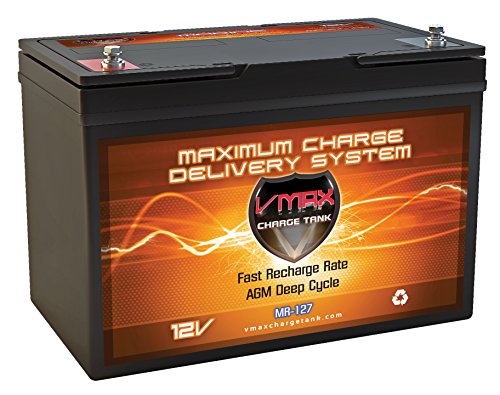
VMAX MR127 12V 100Ah AGM deep cycle battery
$259.96 Published specsSealed and valve regulated, so it never needs water added and resists spilling in a bouncing boat
Best for: A conventional trolling motor bank where the budget rules out lithium
Check price on AmazonAGM is the better lead acid battery for nearly every trolling motor bank, because it is sealed against spilling, needs no water added over its life, and survives the vibration and angles a small boat actually produces. Flooded lead acid still earns its place on a tight budget or in a large bank where the price difference across several batteries adds up, provided the boat has somewhere to mount it upright and vented.
The chemistry inside both is genuinely lead acid: lead plates in an electrolyte, storing energy the same electrochemical way. What differs is how the electrolyte is held. AGM traps it in a fiberglass mat pressed against the plates, sealed and valve regulated so hydrogen and oxygen recombine inside the case under normal use. Flooded lead acid leaves the electrolyte as a free liquid that off-gasses hydrogen while charging and needs its level topped up as water is lost to that process.
No specific flooded battery is linked from this catalog. Searching turns up generic listings whose specifications cannot be verified against a real manufacturer page, and printing an unverified product here is worse than saying plainly that this catalog does not currently carry one. A flooded deep cycle marine battery is a normal thing to buy at a marine chandlery or auto parts counter, and everything below still applies to whichever one you choose.
Peukert exponent: the one number that is actually published
Both chemistries lose usable capacity as the discharge current rises above the twenty hour rate, and the rate at which they lose it is published battery engineering rather than a marketing claim.
AGM's published Peukert exponent of 1.15 is lower than flooded lead acid's 1.25, meaning AGM retains slightly more of its rated capacity at a heavy trolling motor draw.
Published figure A published engineering, regulatory or manufacturer figure. It does not change because somebody disagrees with it.
| Chemistry | Peukert exponent | Depth of discharge convention |
|---|---|---|
| AGM lead acid | 1.15 | 50 percent |
| Flooded lead acid | 1.25 | 50 percent |
Both share the same conventional 50 percent depth of discharge guideline; the exponent is where they diverge.
Maintenance, venting and where each one can actually be mounted
A flooded battery has to stay close to upright, needs its case vented so the hydrogen it produces while charging has somewhere to go, and needs the electrolyte level checked and topped up with distilled water on a schedule, more often in hot weather or with frequent deep cycling. Skip that maintenance and the plates end up exposed to air above a dropping electrolyte level, which damages them permanently. A vented battery box is not optional hardware for a flooded battery, it is the minimum safe way to carry one on a boat.
AGM removes essentially all of that. The electrolyte is locked in the glass mat rather than free to spill, the case is sealed and valve regulated so gas recombines internally under normal charging, and the VMAX MR127's own listing states it can be mounted in any position. That is the single biggest reason AGM has become the default recommendation for a trolling motor bank: nobody has to remember to check it.
Price is the flooded battery argument, and it is a real one
AGM's sealed construction and glass mat separator cost more to build than a simple flooded cell, and that shows up directly on the price tag. the VMAX runs $259.96 for 100 Ah, and a comparable flooded battery at the same capacity typically undercuts that by a meaningful margin at the register. On a single battery boat that gap barely matters. On a bank of three batteries feeding a 36 volt motor, it is real money, and it is the only honest reason to still choose flooded lead acid over AGM today.
Can you mix AGM and flooded batteries in the same bank?
No. The two chemistries want different charging voltages at the absorption and float stages, and wiring them together in parallel forces both onto whatever the charger or the alternator regulator happens to be set for. The mismatched battery either undercharges or overcharges every cycle, and it degrades faster than either one would on its own dedicated charger. If a bank needs to grow, add another battery of the same chemistry and age, not whatever is on the shelf.
Match chemistry, age and rated capacity across every battery in a bank, since a mismatched pair charges both incorrectly for the life of the bank.
Rule of thumb Boating and fishing convention rather than a published standard. Taught everywhere, useful, and not a specification. Nothing enforces it and no body publishes it.
| Factor | Why it matters |
|---|---|
| Chemistry | AGM and flooded want different absorption and float voltages |
| Age | An older battery drags down a newer one and ages it faster in return |
| Rated capacity | Mismatched Ah ratings unbalance current between batteries in parallel |
This is standard battery bank practice rather than a published specification, but it is followed for good reason.
Frequently asked questions
Can I replace a flooded battery with AGM without changing anything else on the boat?
Almost always, yes, provided the physical case size fits the existing tray and the charger has an AGM setting alongside its flooded lead acid mode. Most onboard chargers built in the last decade already select between them per bank. What you gain immediately is no more watering and a battery that survives being mounted at an angle a flooded battery never could.
Do I need a vented battery box for an AGM battery too?
It is still a good idea even though AGM is sealed. A vented box costs little extra and protects against the rare fault condition where a damaged AGM cell vents gas, plus it holds the battery down against a hard wake. It is simply not the safety requirement for AGM that it is for flooded, where hydrogen off-gassing during normal charging is expected and routine.
Which lasts longer on a trolling motor, AGM or flooded lead acid?
AGM generally holds up better under the vibration and partial state of charge cycling a trolling motor bank sees, and its lower Peukert exponent means it delivers slightly more usable capacity at the same draw. Flooded lead acid can match AGM's cycle life on paper if its water level is maintained faithfully, but in practice that maintenance gets skipped and flooded batteries fail from neglect more often than from age.
Is AGM worth the extra cost for a tight budget trolling motor setup?
If the budget genuinely cannot stretch to AGM, flooded lead acid still works and is a legitimate choice, not a compromise to be ashamed of. Just plan for the vented box, the water checks, and mounting it upright. If the budget can stretch even a little, AGM's freedom from maintenance is usually worth more than the price gap once you count the time spent checking water levels over a season.
Does gel count as AGM or as flooded lead acid?
Neither. Gel is its own sealed lead acid chemistry, using a silica thickened electrolyte instead of a glass mat or a free liquid. It shares AGM's sealed, maintenance free construction but generally tolerates high current draws worse, which is why it is less common on trolling motors than AGM despite also needing no watering.
Will an AGM battery register as fully charged on a charger set for flooded lead acid?
It may show a charge, but it is not being charged correctly. A flooded profile's absorption and float voltages are tuned for a battery that can vent gas freely and be topped up, and running AGM on that profile can undercharge it over time or shorten its life through repeated overcharging at float. Select the AGM mode on any charger that offers one.
Get the complete rigging shopping list
Every item in the beginner, intermediate and expert rigs for both a boat and a kayak, with running totals, in one printable list. No charge.
One list, no sequence of daily emails, and you can leave at any time.
Researched, not professional advice. This page is compiled from published engineering and regulatory figures, manufacturer specifications and owner-review consensus, not hands-on testing. Figures described as a rule of thumb are boating convention rather than published standards, and they are labelled that way wherever they appear. Marine electrical work is not house wiring. Use tinned, finely stranded marine cable, size it for voltage drop and for the ABYC E-11 ampacity table rather than one or the other, and put overcurrent protection within seven inches of the battery positive terminal, because everything between the post and the fuse is unprotected. A lithium battery needs a charger with a lithium profile. Never load a boat past its capacity plate, and remember that canoes and kayaks carry no federal capacity plate at all, so their stated capacity is the manufacturer own figure. Wear the life jacket, and treat early season water as the hazard it is: cold water immersion takes your breath and then your hands long before it takes your core.