Batteries and charging
Onboard charger or portable charger for your battery bank?
Quick answer
An onboard charger stays permanently wired to every battery in the bank and charges all of them the moment the boat is plugged into shore power. A portable charger has to be carried to the battery and connected one at a time, which fits a single battery kayak setup better than a boat running two or three batteries that all need charging after every trip.
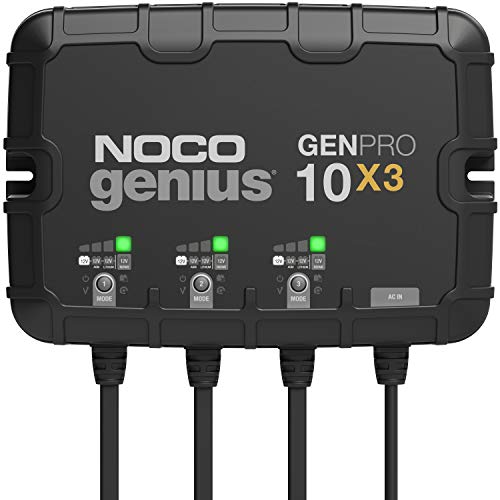
NOCO GENPRO10X3 12V 30A 3-bank onboard charger
$324.95 Published specsWired permanently to all three batteries, with an independently selectable charge profile including lithium on each bank
Check price on AmazonAn onboard charger is the better choice for any boat with more than one battery, because it stays wired to the whole bank and charges every battery in it the moment shore power is connected, with no clamps to find or connect by hand. A portable charger is the better choice for a single battery setup, especially a kayak, where the battery comes off the boat after every trip anyway and a permanently wired charger has nothing to stay wired to.
The two are not really competing products so much as answers to two different boats. A powerboat with a bow mount motor and two or three batteries permanently installed in the hull wants a charger that lives there too. A kayak, a portable fish finder battery, or a single small boat with one battery that gets carried inside for the winter wants a charger that comes and goes with the battery instead.
What an onboard charger actually does
An onboard charger like NOCO GENPRO10X3 12V 30A 3-bank onboard charger wires permanently to every battery in the bank through its own dedicated output, called a bank. Plug the boat into shore power and it charges all of them independently, automatically, at whatever profile each bank is set to. That per-bank independence matters: a charger's amp rating is per bank, not a total split across every output. A 3-bank charger rated at 10 amps per bank delivers 10 amps to each of three batteries at once, 30 amps total, not 10 amps divided three ways.
Lead acid is conventionally charged at roughly 10 to 13 percent of bank capacity, while LiFePO4 tolerates a much higher rate, commonly cited around 20 percent, which is why a lithium bank recharges faster on the same charger.
Rule of thumb Boating and fishing convention rather than a published standard. Taught everywhere, useful, and not a specification. Nothing enforces it and no body publishes it.
| Chemistry | Typical charge rate | Basis |
|---|---|---|
| AGM or flooded lead acid | About 10 to 13 percent of bank Ah | Convention, protects plate life |
| LiFePO4 lithium | Commonly around 20 percent of bank Ah | Manufacturer guidance, not a hard limit |
These are planning figures. The battery and charger manufacturer specifications for your specific pair govern.
What a portable charger trades away, and what it gains
A portable charger has no permanent wiring at all. You carry it to the battery, clip or bolt the leads on, and plug it into a wall outlet, then disconnect it when charging finishes. That is exactly right for a battery that already gets carried somewhere else between trips, such as a kayak battery box or a small sealed lead acid pack running a portable fish finder, since there is nothing on the boat for a permanent charger to stay wired to anyway. It is the wrong tool for a bank of two or three batteries that live permanently in the hull, since charging them one at a time with a portable unit means physically reaching each one in turn instead of plugging in once and walking away.
Lithium profile matters on both types
A lithium battery needs a charger with a lithium profile, and that requirement does not go away just because the charger is portable rather than onboard. Every NOCO onboard charger in this catalog includes a selectable lithium mode per bank, which is one reason NOCO shows up so often as the recommended pairing for a new lithium purchase. A portable charger bought for a single lithium battery needs the same check: confirm it has an explicit LiFePO4 or lithium setting before assuming a lead acid profile will do the job safely.
Frequently asked questions
Can a portable charger charge a boat with a 3 bank onboard system already wired in?
Yes, but only one battery at a time and only by physically accessing each battery's terminals, which defeats most of the convenience of having an onboard system in the first place. If the boat already has onboard charger wiring installed, using it as intended is faster and does not require reaching into the battery compartment after every trip.
Does an onboard charger's amp rating apply per bank or to the whole unit?
Per bank. A charger listed as 3 banks at 10 amps delivers 10 amps to each of the three batteries simultaneously, for 30 amps total output, not 10 amps shared across all three. Always check whether a spec sheet is quoting per-bank or total amperage before comparing two chargers on price, since the numbers are not interchangeable.
Do I need to check for a lithium profile on a portable charger too?
Yes, exactly as with an onboard unit. A lead acid charging profile on a portable charger is just as wrong for a LiFePO4 battery as it is on a permanently wired one: it either fails to reach the voltage the pack needs to fill or holds it at a float voltage the pack should not sit at for long periods.
Which is better for a kayak, a portable charger or an onboard charger?
A portable charger, in almost every case. A kayak's single battery typically comes off the hull after every trip to charge indoors or in a garage, so there is nothing for a permanently wired onboard charger to stay connected to. A small single bank portable charger with the correct chemistry profile is the simpler and cheaper answer.
Can I leave an onboard charger connected to shore power all the time?
Genuine marine onboard chargers are built for exactly that, cycling automatically into a maintenance or float stage once the bank reaches full charge and holding it there safely for extended periods. Check the specific charger's documentation to confirm indefinite connection is supported, since this is a real design feature rather than something that applies to every charger by default.
Is a portable charger cheaper than an onboard charger overall?
For a single battery, generally yes, since it has one output and none of the wiring and mounting hardware an onboard install needs. For a bank of two or more batteries, the comparison flips once you count the time cost of manually charging each battery in turn, and most boats with more than one battery are better served by an onboard multi-bank unit despite its higher price.
Get the complete rigging shopping list
Every item in the beginner, intermediate and expert rigs for both a boat and a kayak, with running totals, in one printable list. No charge.
One list, no sequence of daily emails, and you can leave at any time.
Researched, not professional advice. This page is compiled from published engineering and regulatory figures, manufacturer specifications and owner-review consensus, not hands-on testing. Figures described as a rule of thumb are boating convention rather than published standards, and they are labelled that way wherever they appear. Marine electrical work is not house wiring. Use tinned, finely stranded marine cable, size it for voltage drop and for the ABYC E-11 ampacity table rather than one or the other, and put overcurrent protection within seven inches of the battery positive terminal, because everything between the post and the fuse is unprotected. A lithium battery needs a charger with a lithium profile. Never load a boat past its capacity plate, and remember that canoes and kayaks carry no federal capacity plate at all, so their stated capacity is the manufacturer own figure. Wear the life jacket, and treat early season water as the hazard it is: cold water immersion takes your breath and then your hands long before it takes your core.