Trolling motor sizing
Trolling motor shaft length calculator
Quick answer
Measure from the mounting surface down to the waterline, then add 16 inches for sheltered water or 20 for rough, and round up to a stocked length. A 24 inch bow height therefore wants a 42 inch shaft on a calm lake and a 45 inch shaft on open water.
Almost every complaint about a correctly sized trolling motor turns out to be a shaft length problem. If the prop breaks the surface when the bow lifts over a wave, the motor loses bite, the pitch changes and the noise scares fish. That is called ventilating, and it is what a short shaft does.
The measurement is simple and people still get it wrong. It is from the surface the motor bolts to, which on most boats is the bow deck, straight down to the waterline with the boat loaded the way you fish it. Not from the gunwale, not from the deck of an empty boat on a trailer.
Run your own measurement
A 24 inch bow height points at a 42 inch shaft for sheltered water and a 45 inch shaft for rough.
| Figure | Value |
|---|---|
| Measured bow height | 24 in |
| Allowance | 16 in |
| Shaft length needed | 40 in |
| Smallest stocked shaft | 42 in |
| If you fish rough water | 45 in |
Shown with the example figures above. Change any field to run your own numbers.
The working
Rule of thumbshaft needed = bow-to-waterline height + allowance allowance = 16 in sheltered water = 20 in rough water then round UP to the nearest stocked length
The 16 and 20 inch allowances are boating convention rather than a published standard. Boating and fishing convention rather than a published standard. Taught everywhere, useful, and not a specification. Nothing enforces it and no body publishes it.
Motors and the parts that go with them
Shaft lengths shown are the manufacturer own published figures. Check the shaft on the exact listing before ordering, because most motors are sold in several lengths under one name.

Minn Kota Riptide Terrova 80 saltwater, 60 inch shaft
$2,699.99 Published specsThe saltwater build, with the sacrificial anode and sealed hardware that decides whether a bow motor survives its second season in salt.
Best for: Any boat that touches salt or brackish water
Check price on Amazon
Minn Kota Terrova 112 with Spot-Lock and MEGA Down Imaging, 60 inch shaft
$2,399.99 Published specsThe 36 volt Terrova, for a heavy boat or genuinely windy water, and the point at which the boat carries three batteries.
Check price on Amazon
Minn Kota Terrova 80 with Spot-Lock and MEGA Down Imaging, 60 inch shaft
$2,299.99 Published specsEighty pounds of thrust on 24 volts with a MEGA Down Imaging transducer built into the shaft, which removes a separate bow transducer entirely.
Check price on Amazon
Minn Kota Terrova 55 with GPS and Spot-Lock, 54 inch shaft
$1,649.99 Published specsThe default bow mount on a huge number of boats: Spot-Lock, a stow and deploy lever that works with one hand, and 12 volt simplicity.
Best for: The buy-once bow motor for a single battery freshwater boat
Check price on Amazon
Minn Kota PowerDrive 55 with GPS and CHIRP sonar, 54 inch shaft
$1,252.99 Published specsSpot-Lock GPS anchoring and a built in sonar transducer on a 12 volt motor, which is the cheapest way to get GPS anchoring on one battery.
Best for: A boat under about 2,500 lb loaded that runs a single battery
Check price on Amazon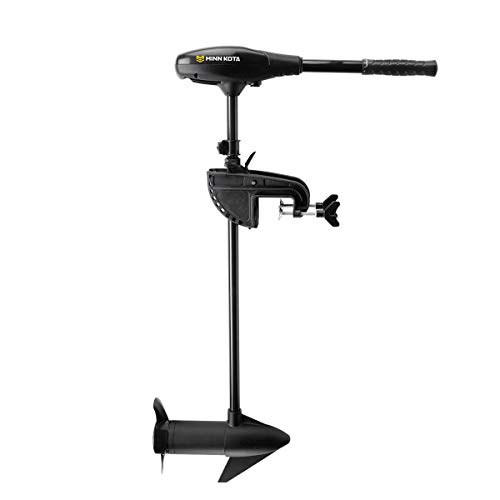
Minn Kota Endura Max 55, 42 inch shaft
$329.99 Published specsThe largest 12 volt transom motor worth fitting, and the ceiling for what a single battery can usefully drive.
Check price on AmazonEvery figure shown is the manufacturer own published specification. The rating on the unit you receive is what governs, and the capacity plate on your own boat governs everything above it.
How to take the measurement
- Load the boat the way you fish it. People, gear, batteries and fuel aboard. An empty boat floats higher, which makes the bow to waterline distance shorter and produces a shaft that is too short on the day.
- Measure from the mounting surface, not the rail. On a bow mount, that is the flat deck the bracket bolts to. On a transom mount, it is the top of the transom where the clamp sits. Measuring from a rail or a gunwale adds inches that are not there.
- Measure straight down to the water. Vertically, with the boat at rest and level. Running a tape along the sloping bow adds length and is the second most common error here.
- Add the allowance. Sixteen inches for sheltered water, twenty for anywhere the bow lifts. That allowance is what keeps the prop buried when the hull moves, and it is convention rather than a published figure.
- Round up to a stocked length. Shafts come in fixed lengths. If you are between two, take the longer one: a shaft slightly too long can be trimmed in how you set the motor, and one too short cannot be fixed at all.
Stocked shaft lengths
Add 16 inches for sheltered water and 20 for rough to the measured bow height, then round up to a stocked shaft.
Rule of thumb Boating and fishing convention rather than a published standard. Taught everywhere, useful, and not a specification. Nothing enforces it and no body publishes it.
| Bow to waterline | Sheltered, plus 16 in | Rough, plus 20 in | Stocked shaft, sheltered |
|---|---|---|---|
| 10 in | 26 in | 30 in | 30 in |
| 12 in | 28 in | 32 in | 30 in |
| 14 in | 30 in | 34 in | 30 in |
| 16 in | 32 in | 36 in | 36 in |
| 18 in | 34 in | 38 in | 36 in |
| 20 in | 36 in | 40 in | 36 in |
| 22 in | 38 in | 42 in | 42 in |
| 24 in | 40 in | 44 in | 42 in |
| 26 in | 42 in | 46 in | 42 in |
| 28 in | 44 in | 48 in | 45 in |
| 30 in | 46 in | 50 in | 48 in |
| 34 in | 50 in | 54 in | 52 in |
| 38 in | 54 in | 58 in | 54 in |
Stocked lengths are 30, 36, 42, 45, 48, 52, 54, 60, 62, 72, 87 inches. The plus 16 and plus 20 allowances are boating convention rather than a published specification, and individual manufacturers publish their own recommendation tables which should be used where you have one.
Why too long is safer than too short
A shaft an inch or two longer than needed sits slightly deeper, which costs a little efficiency and nothing else. A shaft an inch too short ventilates every time the bow lifts, and there is no adjustment that fixes it. You are buying a new motor or living with it.
Kayaks and sit on top hulls are the exception worth naming: there the constraint is usually the opposite, and a 24 to 36 inch shaft built for a kayak is a genuinely different product rather than a cut down boat motor.
Frequently asked questions
How do I measure for a trolling motor shaft?
Load the boat the way you fish it, then measure vertically from the surface the motor bolts to down to the waterline. On a bow mount that is the bow deck, and on a transom mount it is the top of the transom. Add 16 inches for sheltered water or 20 for rough, then round up to a stocked shaft length.
What happens if the shaft is too short?
The prop breaks the surface when the bow lifts, which is called ventilating. The motor loses bite, the pitch changes audibly and the noise pushes fish away. It happens exactly when you need control most, in wind and chop, and no adjustment fixes it. This is the single most common complaint about an otherwise correctly sized motor.
Can a shaft be too long?
Mildly. A longer shaft sits deeper, which costs a small amount of efficiency and makes the motor more likely to find bottom in very shallow water. Against that, it stows higher and may foul the deck. Between two stocked lengths, taking the longer one is the safer error because the shorter one cannot be corrected.
Is the allowance 16 inches or 20?
Sixteen is the figure for sheltered water where the bow stays put, and twenty is for anywhere the hull moves in chop or where you fish standing on a raised deck. Both are convention repeated across the industry rather than a published standard. Where your motor maker publishes its own table, that figure governs instead.
Do kayaks use the same calculation?
The measurement is the same but the answer is much shorter, and the constraint is different. Kayak specific motors come with 24 to 36 inch shafts, which is a genuinely different product rather than a boat motor cut down. A boat shaft on a kayak stows badly and puts the head of the motor somewhere you cannot reach from the seat.
Does shaft length affect thrust?
Not directly, but it decides whether you get the thrust you paid for. A ventilating prop is delivering a fraction of its rating regardless of the number on the box, so shaft length and thrust are two halves of the same decision. Size the thrust from your loaded boat weight and the shaft from your loaded bow height.
Get the complete rigging shopping list
Every item in the beginner, intermediate and expert rigs for both a boat and a kayak, with running totals, in one printable list. No charge.
One list, no sequence of daily emails, and you can leave at any time.
Researched, not professional advice. This page is compiled from published engineering and regulatory figures, manufacturer specifications and owner-review consensus, not hands-on testing. Figures described as a rule of thumb are boating convention rather than published standards, and they are labelled that way wherever they appear. Marine electrical work is not house wiring. Use tinned, finely stranded marine cable, size it for voltage drop and for the ABYC E-11 ampacity table rather than one or the other, and put overcurrent protection within seven inches of the battery positive terminal, because everything between the post and the fuse is unprotected. A lithium battery needs a charger with a lithium profile. Never load a boat past its capacity plate, and remember that canoes and kayaks carry no federal capacity plate at all, so their stated capacity is the manufacturer own figure. Wear the life jacket, and treat early season water as the hazard it is: cold water immersion takes your breath and then your hands long before it takes your core.