Wiring and protection
Marine fuse and breaker sizing calculator
Quick answer
A 50 amp continuous load conventionally takes a device at least twenty five percent above it, which is 62.5 amps and rounds up to a stocked 70 amp breaker. It must sit within seven inches of the battery positive terminal under ABYC E-11, because everything before it is unprotected.
Two numbers decide overcurrent protection, and only one of them is arithmetic. The size comes from the continuous load with a margin, capped by the conductor ampacity. The position is specified rather than suggested, and it is the part people get wrong.
There is also a third rule that beats both: where the equipment manufacturer publishes a specific device size, that figure governs and no calculation overrides it. Trolling motor makers publish breaker sizes for their own motors, and this calculator shows them rather than pretending its own arithmetic is better.
Size your own protection
A 50 amp continuous load points at a 70 amp device, within 7 inches of the battery positive terminal.
| Figure | Value |
|---|---|
| Continuous load | 50 A |
| At 1.25 times | 62.5 A |
| Nearest standard size | 70 A |
| Maximum distance from battery | 7 in |
| Minimum cable for 20 ft at 12 V | 2 AWG |
| Conductor ampacity | not published, check ABYC E-11 |
Shown with the example figures above. Change any field to run your own numbers.
The working
Published figuredevice size >= continuous load x 1.25 then round UP to a standard size and confirm it is AT OR BELOW the conductor ampacity placement: within 7 in of the battery positive terminal 40 in if the conductor is in a sheath
The 1.25 factor for continuous loads is convention. The placement distances are ABYC E-11 and are specified rather than recommended. Where the equipment maker publishes a device size, that figure governs instead. A published engineering, regulatory or manufacturer figure. It does not change because somebody disagrees with it.
Protection and distribution
Marine rated devices only. The car audio market floods the ANL fuse holder category with parts whose own titles say they are for car stereo systems, and none of those are here.

Blue Sea Systems Add-A-Battery kit, 120A
$175.34A switch and an automatic charging relay together, which charges the second battery from the outboard without letting the electronics flatten the cranking battery.
Best for: Adding a house battery without being able to flatten the one that starts the engine
Check price on Amazon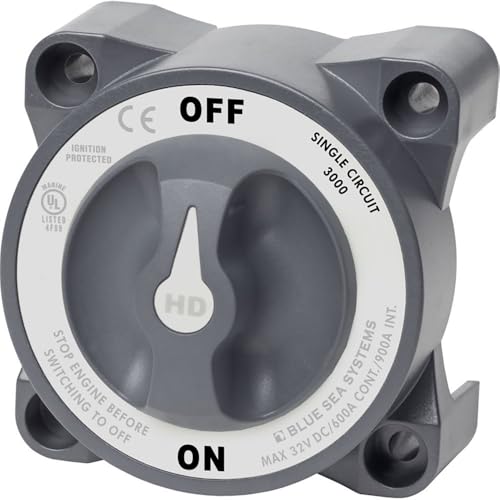
Blue Sea Systems HD-Series on/off battery switch, 500A
$79.00Rated for 500 amps, which is the switch a 36 volt motor bank and a big cranking battery actually need.
Check price on Amazon
Blue Sea Systems 285-Series surface mount circuit breaker, 50A
$58.74A resettable breaker rather than a fuse, at the size a 55 lb thrust motor calls for.
Check price on Amazon
Blue Sea Systems 285-Series surface mount circuit breaker, 60A
$50.73Sixty amps, which is the size Minn Kota specifies for its 70 lb and larger motors.
Best for: A 70 to 112 lb thrust trolling motor feed
Check price on Amazon
Blue Sea Systems e-Series 4-position selector battery switch
$49.51One, two, both or off, which is how a boat with a cranking battery and a house battery is supposed to be wired.
Check price on Amazon
Blue Sea Systems ST Blade water-resistant fuse block, 80A
$44.00A manual cover that keeps spray off the fuses, for a block that has to live somewhere exposed.
Check price on AmazonEvery figure shown is the manufacturer own published specification. The rating on the unit you receive is what governs, and the capacity plate on your own boat governs everything above it.
Where the device has to sit
Protection goes within seven inches of the battery positive terminal, extended to forty inches only when the conductor is inside a sheath or enclosure.
Published figure A published engineering, regulatory or manufacturer figure. It does not change because somebody disagrees with it.
| Condition | Maximum distance from the battery | Why |
|---|---|---|
| Conductor not in a sheath or enclosure | 7 inches | Everything between the battery post and the device is unprotected cable |
| Conductor inside a sheath or enclosure | 40 inches | The sheath reduces the chance of the unprotected section chafing to a fault |
| Cranking circuit to the starter | Specific exemptions apply | Check E-11 directly rather than applying the general rule |
A battery can deliver thousands of amps into a dead short. The unprotected section between the post and the device is the part of a boat electrical system with the least margin for error, which is why the distance is specified rather than recommended.
Published breaker sizes for trolling motors
Where a motor maker publishes a breaker size, use theirs rather than a calculated one. The calculated figure is what you fall back on when nobody publishes anything.
Published figure A published engineering, regulatory or manufacturer figure. It does not change because somebody disagrees with it.
| Thrust | Volts | Published maximum draw | Calculated at 1.25x | Nearest stocked device |
|---|---|---|---|---|
| 30 lb | 12 V | 30 A | 37.5 A | 40 A |
| 40 lb | 12 V | 42 A | 52.5 A | 60 A |
| 45 lb | 12 V | 42 A | 52.5 A | 60 A |
| 50 lb | 12 V | 42 A | 52.5 A | 60 A |
| 55 lb | 12 V | 50 A | 62.5 A | 70 A |
| 70 lb | 24 V | 42 A | 52.5 A | 60 A |
| 80 lb | 24 V | 56 A | 70.0 A | 70 A |
| 101 lb | 36 V | 46 A | 57.5 A | 60 A |
| 112 lb | 36 V | 52 A | 65.0 A | 70 A |
These draw figures are the commonly published manufacturer values at maximum thrust and a specific model can differ. Check the figure in the manual for your own motor. Minn Kota, for example, publishes a 60 amp breaker for most of its larger motors regardless of what the arithmetic suggests.
Fuse or breaker
A fuse is cheaper, smaller, and has to be replaced after it operates, which means carrying spares. An ANL or MRBF fuse at the battery is the normal choice for a main feed. A breaker costs more, resets, and can double as a switch so you can isolate a circuit without pulling a fuse.
For a trolling motor feed the resettable breaker is the usual answer, because a motor that trips its protection in weed is a thing that happens and you want to be fishing again in ten seconds rather than looking for a spare fuse in the rain.
The device cannot be larger than the cable can carry
This is the constraint that makes the calculated size a ceiling rather than a target. Overcurrent protection exists to protect the conductor, not the appliance. A 100 amp breaker on a cable that can only carry 60 amps means the cable becomes the fuse, which is how a wiring loom catches fire with the protection intact.
So the device has to be at or below the conductor ampacity, and we deliberately publish no ampacity figure indexed by gauge, because ABYC E-11 ampacity depends on insulation temperature rating, engine space location and conductor bundling. Check E-11 for your own installation and confirm the device is inside it.
Frequently asked questions
What size breaker do I need for my trolling motor?
Use the figure the motor manufacturer publishes if there is one, which for most larger Minn Kota motors is 60 amps. Where nobody publishes a size, the convention is at least twenty five percent above the continuous draw, so a 50 amp draw points at 62.5 amps and rounds up to a stocked 70 amp device. It must also be at or below the conductor ampacity.
How close to the battery does the fuse have to be?
Within seven inches of the point the conductor connects to the battery under ABYC E-11, extended to forty inches when the conductor runs inside a sheath or enclosure. The reason is that everything between the battery post and the device is unprotected cable, and a battery can deliver thousands of amps into a dead short before anything else notices.
Fuse or circuit breaker?
A fuse is cheaper and smaller and has to be replaced after it operates, so you carry spares. A breaker resets and can double as an isolating switch. For a trolling motor feed most people fit a resettable breaker, because tripping in weed happens and you want to be fishing again in ten seconds rather than searching for a spare fuse.
Why does overcurrent protection exist?
To protect the conductor, not the appliance. That is the thing that makes the sizing rule work in one direction only: the device must be at or below what the cable can safely carry. A breaker larger than the cable ampacity means the cable becomes the fuse, which is how a loom catches fire with the protection apparently intact.
Can I fit a bigger breaker if mine keeps tripping?
No, and this is the most dangerous instinct in boat wiring. A breaker that trips repeatedly is reporting a real problem: a motor working too hard, a chafed conductor, a failing connection or an undersized cable. Fitting a larger device removes the report rather than the fault, and the cable is then unprotected at the current that was tripping it.
Does a 24 or 36 volt motor need a bigger breaker?
Usually not, and frequently the opposite. A higher voltage motor delivers the same power at a lower current, so an 80 lb motor at 24 volts draws 56 amps and a 112 lb motor at 36 volts draws 52. The breaker follows the current rather than the thrust, which is why the largest motors do not need the largest devices.
Get the complete rigging shopping list
Every item in the beginner, intermediate and expert rigs for both a boat and a kayak, with running totals, in one printable list. No charge.
One list, no sequence of daily emails, and you can leave at any time.
Researched, not professional advice. This page is compiled from published engineering and regulatory figures, manufacturer specifications and owner-review consensus, not hands-on testing. Figures described as a rule of thumb are boating convention rather than published standards, and they are labelled that way wherever they appear. Marine electrical work is not house wiring. Use tinned, finely stranded marine cable, size it for voltage drop and for the ABYC E-11 ampacity table rather than one or the other, and put overcurrent protection within seven inches of the battery positive terminal, because everything between the post and the fuse is unprotected. A lithium battery needs a charger with a lithium profile. Never load a boat past its capacity plate, and remember that canoes and kayaks carry no federal capacity plate at all, so their stated capacity is the manufacturer own figure. Wear the life jacket, and treat early season water as the hazard it is: cold water immersion takes your breath and then your hands long before it takes your core.