Electrical
Which marine fuse block or switch should you buy?
Quick answer
ABYC E-11 requires overcurrent protection within 7 inches of the battery positive terminal, extended to 40 inches inside a sheath. Everything between the post and that fuse is unprotected, which is why the Blue Sea ANL fuse block is usually the first thing wired to a new battery.
A battery bank can push enough current into a chafed or shorted cable to start a fire, and the only thing standing between that cable and a spark is a fuse or breaker sized and placed correctly. ABYC E-11 does not leave the placement to judgment: overcurrent protection belongs within 7 inches of the battery positive terminal, or 40 inches if the conductor runs inside a sheath or enclosure the rest of the way.
A fuse block gathers several of those protected circuits into one place with a shared negative bus, while a battery switch isolates the whole bank so the boat can be worked on without pulling terminals off the posts. Both jobs are separate from wire sizing, which is governed by voltage drop and by an ABYC ampacity table this site does not reduce to a single number by gauge, since ampacity depends on insulation rating, engine space location and how many conductors are bundled together.
Circuit counts, amp ratings and certifications below come from each product's own Amazon listing.
On this page
How this list was put together
None of these fuse blocks or switches were wired into a running boat to confirm their published ratings. Every circuit count, amp rating and certification below comes from each product's own listing, checked against the maker's stated specifications rather than assumed from a similar-looking part.
Where does ABYC E-11 actually require the fuse to be?
Overcurrent protection belongs within 7 inches of the battery positive terminal, extended to 40 inches when the conductor runs inside a sheath.
Published figure A published engineering, regulatory or manufacturer figure. It does not change because somebody disagrees with it.
| Installation | Maximum distance from the battery positive terminal |
|---|---|
| Unsheathed conductor | 7 inches |
| Conductor inside a sheath or enclosure | 40 inches |
This is the published ABYC E-11 rule, not a rule of thumb. Everything on the cable between the battery post and the fuse or breaker has no overcurrent protection at all.
Fuse block or circuit breaker?
The Blue Sea 12-circuit ST Blade block supports up to 30A per circuit within a 100A total block rating.
Published figure A published engineering, regulatory or manufacturer figure. It does not change because somebody disagrees with it.
| Product | Circuits | Amps per circuit (with ATO/ATC fuses) | Block rating |
|---|---|---|---|
| Blue Sea ST Blade, 4 circuits | 4 | up to 30A | 100A |
| Blue Sea ST Blade, 6 circuits with negative bus | 6 | up to 30A | 100A |
| Blue Sea ST Blade, 12 circuits with negative bus | 12 | up to 30A | 100A |
| Blue Sea ANL fuse block | 1 main feed | 35 to 300A fuse range | matches the fuse installed |
A fuse block's total rating is the maximum draw across all circuits combined, published by the manufacturer, not a sum that each circuit can hit simultaneously without exceeding it.
On/off switch or selector switch?
A simple on/off switch, like the Blue Sea Systems m-Series on/off battery switch, isolates a single battery so the boat can be serviced without pulling cables off the posts. A four position selector switch, like the Blue Sea Systems e-Series 4-position selector battery switch, adds One, Two, Both and Off positions for a boat running a separate cranking battery and house battery, which a single on/off switch cannot do. An add-a-battery kit, like the Blue Sea Systems Add-A-Battery kit, 120A, goes further still by combining an automatic charging relay with the switch, so a second battery charges from the outboard without risking the one that starts the engine.
Best budget fuse block and switch
A small boat or kayak with a handful of accessories needs a compact block and a basic way to isolate the battery, not a full panel.
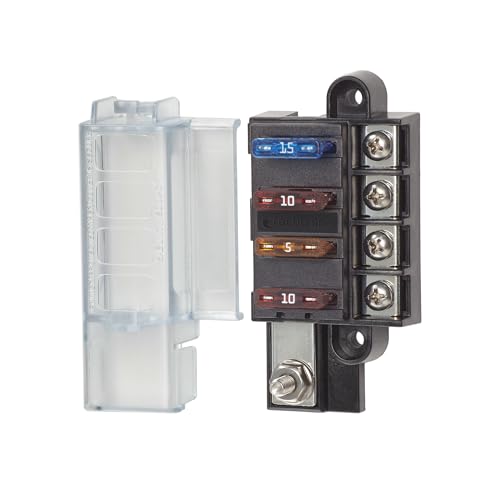
Blue Sea Systems ST Blade compact fuse block, 4 circuits
$28.00Four fused circuits in a compact footprint, the right size for a kayak or jon boat running only a sonar, a light and a pump.
Best for: A small boat or kayak with just a few accessories
Check price on Amazon
Blue Sea Systems m-Series on/off battery switch
$27.05Isolates the battery with one turn, which is the cheapest way to work on a boat without pulling terminals off posts.
Best for: A first proper battery switch on a simple single battery boat
Check price on AmazonBest fuse block and switch for most boats
Most boats with sonar, lighting, a livewell pump and a bilge pump outgrow inline fuses and need a real panel with a negative bus.
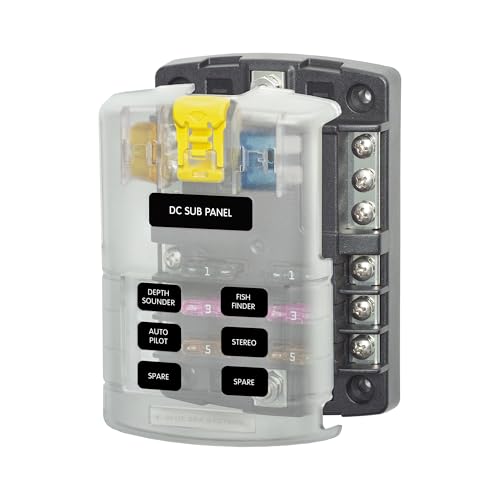
Blue Sea Systems ST Blade fuse block, 6 circuits with negative bus
$31.15Six fused circuits and a common negative bus, which is the whole electrical panel on most small fishing boats.
Best for: Replacing inline fuses taped behind the console
Check price on Amazon
Blue Sea Systems e-Series 4-position selector battery switch
$49.51One, Two, Both or Off positions for a boat running a separate cranking battery and house battery.
Best for: A boat with two batteries that need independent control
Check price on AmazonBest heavy duty battery switch
A large 36 volt motor bank plus a separate cranking battery pushes past what a standard switch is rated to handle.
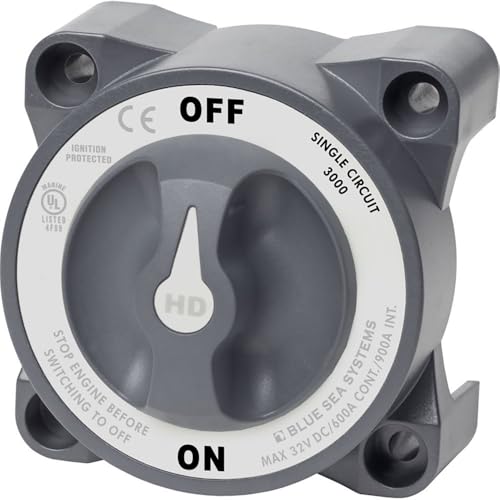
Blue Sea Systems HD-Series on/off battery switch, 500A
$79.00Rated for 500 amps continuous, the switch a 36 volt motor bank and a large cranking battery actually call for.
Best for: Larger boats running a 36 volt motor bank plus a separate cranking battery
Check price on AmazonWho should not buy this tier: A kayak, a jon boat, or any single-battery system where nothing in the boat draws anywhere close to 500 amps. The compact 4-circuit block and a basic on/off switch handle that job for a fraction of the price.
How we chose
We did not test this equipment in person and we never claim to. Picks are researched from manufacturer specification sheets, published engineering and regulatory figures, and the recurring themes in verified owner reviews. Every pick is matched to a real thrust rating, a real published amp draw, a real capacity or a real conductor size rather than to a price bracket, and it is placed in the tier where its published capability actually belongs. We rejected the unbranded flood that dominates several of these search results, because a lithium pack whose management board is the only thing between a cell fault and a fire, a breaker protecting a battery cable, a life jacket and a bracket holding a two thousand dollar motor to the bow at highway speed are all parts whose failure has a consequence nobody can walk away from. Where a figure is convention rather than a published standard we label it that way, and where a manufacturer does not publish a figure we leave it out instead of estimating it.
Frequently asked questions
Why does the fuse have to be so close to the battery?
Because everything on the cable between the battery post and the fuse has no overcurrent protection at all. ABYC E-11 requires that protection within 7 inches of the battery positive terminal, or up to 40 inches if the conductor runs inside a sheath or enclosure the rest of the way. A battery can deliver enough current into a chafed or shorted cable to start a fire, and moving the fuse further away only lengthens the unprotected section.
What is the difference between a fuse block and a circuit breaker panel?
A fuse block protects several circuits with replaceable ATO or ATC fuses and a shared negative bus, and a blown fuse has to be swapped out to restore that circuit. A circuit breaker does the same protective job but resets with a lever instead of a replacement part, which is convenient at the panel but is a separate purchase decision from the fuse or breaker required within inches of the battery itself under ABYC E-11.
How do I size a breaker for a trolling motor circuit?
Where the motor manufacturer publishes a specific fuse or breaker size, use that figure; it accounts for the motor's actual current draw better than a general formula does. Where none is published, sizing at roughly 25 percent above the motor's continuous current draw is boating convention, not a published standard, and the resulting breaker still has to sit at or below what the conductor feeding it can safely carry.
What is the difference between an on/off switch and a selector switch?
An on/off switch isolates one battery from the rest of the system with a single turn, which is enough for a boat with a single battery bank. A selector switch adds positions, commonly One, Two, Both and Off, so a boat running a separate cranking battery and house battery can choose which bank is in the circuit or combine them in an emergency, a job a simple on/off switch cannot do on its own.
Does a lithium battery need different fuse or switch hardware than lead acid?
The fuse block, breaker and switch hardware itself does not change with battery chemistry, since they are all rated by voltage and current rather than by what is inside the battery. What does matter is confirming the switch and any breaker are rated for the system voltage in use and for the current the motor or charger can actually pull, which is the same check regardless of whether the bank is AGM or lithium.
Can I mount the main fuse anywhere convenient in the boat?
No. ABYC E-11 ties its location to the battery, not to whatever spot is easiest to reach: within 7 inches of the battery positive terminal, or 40 inches if the cable is inside a sheath. Planning the battery box or tray location with that distance in mind, rather than adding the fuse as an afterthought once the battery is already installed, is the difference between a compliant installation and one that only looks tidy.
Get the complete rigging shopping list
Every item in the beginner, intermediate and expert rigs for both a boat and a kayak, with running totals, in one printable list. No charge.
One list, no sequence of daily emails, and you can leave at any time.
Researched, not professional advice. This page is compiled from published engineering and regulatory figures, manufacturer specifications and owner-review consensus, not hands-on testing. Figures described as a rule of thumb are boating convention rather than published standards, and they are labelled that way wherever they appear. Marine electrical work is not house wiring. Use tinned, finely stranded marine cable, size it for voltage drop and for the ABYC E-11 ampacity table rather than one or the other, and put overcurrent protection within seven inches of the battery positive terminal, because everything between the post and the fuse is unprotected. A lithium battery needs a charger with a lithium profile. Never load a boat past its capacity plate, and remember that canoes and kayaks carry no federal capacity plate at all, so their stated capacity is the manufacturer own figure. Wear the life jacket, and treat early season water as the hazard it is: cold water immersion takes your breath and then your hands long before it takes your core.