Batteries
Which AGM deep cycle battery should you buy?
Quick answer
A 100 Ah AGM battery will not run a 50 amp motor for two hours. Peukert's equation puts the real runtime near an hour and 25 minutes, and the 50 percent depth of discharge convention says to recharge around 40 minutes to protect cycle life. The VMAX MR127 is the AGM most often recommended for 40 to 100 lb motors.
AGM is still what most trolling motor batteries on the water actually are: a third the price of lithium, roughly twice the weight for the same rated capacity, and a battery whose printed amp hour number means something different than most buyers assume. The rating on the case is measured over a 20 hour discharge, and pulling current faster than that returns noticeably less capacity, which is published battery engineering rather than a marketing footnote.
A second number gets confused with the first. Peukert's equation describes how delivered capacity falls as discharge current rises, and it is a published relationship. The 50 percent depth of discharge guideline is something else entirely: boating convention built to protect cycle life, taught everywhere, and published by no standards body. Both matter, and neither is optional to understand before buying a 100 Ah battery expecting 100 Ah of usable run time.
Every capacity, chemistry and group size below comes from each battery's own Amazon listing, checked against the manufacturer's stated specifications rather than assumed from the case size alone.
On this page
- How this list was put together
- Why doesn't a 100 Ah AGM run a 50 amp motor for two hours?
- How does the 50 percent depth of discharge guideline change that number again?
- AGM or flooded, and does group size matter?
- Best budget AGM for small motors
- Best all-around AGM deep cycle battery
- Best high performance AGM
How this list was put together
None of these batteries were run down against a clamp meter to confirm the manufacturer's numbers. Every figure below is the published rating from the battery's own listing, and the runtime math is Peukert's published equation applied to that rating, not a measurement taken on the water.
Why doesn't a 100 Ah AGM run a 50 amp motor for two hours?
Simple division says 100 Ah divided by 50 A equals two hours, and simple division is wrong here because a lead acid battery does not deliver its full rated capacity when discharged quickly. Peukert's equation, published battery engineering rather than a rule of thumb, describes exactly how much capacity is lost as the draw goes up.
A 100 Ah AGM battery run at 50 amps empties in about 1.4 hours, not the 2 hours simple division suggests.
Published figure A published engineering, regulatory or manufacturer figure. It does not change because somebody disagrees with it.
| Chemistry | Peukert exponent | Hours to fully empty a 100 Ah battery at 50A |
|---|---|---|
| AGM lead acid | 1.15 | about 1.4 hours |
| Flooded lead acid | 1.25 | about 1.1 hours |
| LiFePO4 lithium | 1.02 | about 1.9 hours |
This is Peukert's published equation applied to a 100 Ah rated battery at a 50 amp draw. It describes delivered capacity, not the separate depth of discharge guideline below.
How does the 50 percent depth of discharge guideline change that number again?
Depth of discharge is a different idea from Peukert's equation, and the two get mixed together constantly. Peukert describes how much a battery can physically deliver at a given draw. Depth of discharge is convention layered on top of that, built to protect how many cycles the battery has left rather than describing a physical limit, and lead acid and lithium are not treated the same way.
The 50 percent depth of discharge convention cuts that same AGM battery's usable runtime to about 40 minutes before recharging protects its cycle life.
Rule of thumb Boating and fishing convention rather than a published standard. Taught everywhere, useful, and not a specification. Nothing enforces it and no body publishes it.
| Chemistry | Recommended depth of discharge | Usable runtime at a 50A draw |
|---|---|---|
| AGM or flooded lead acid | 50 percent | about 40 minutes |
| LiFePO4 lithium | 80 percent | about 1 hour 32 minutes |
No standards body publishes a depth of discharge figure. It is boating and RV convention built to protect cycle life, and lithium makers publish a usable depth well above the lead acid guideline because the chemistry tolerates deeper cycling.
AGM or flooded, and does group size matter?
Group size describes the case dimensions and terminal layout more than anything electrical, and matching the tray a boat already has usually decides the choice before amp hours enter the conversation. A Group 31 case like the VMAX MR137-120 12V 120Ah AGM Group 31 battery holds more lead and more amp hours than a Group 24 or Group 27 case of the same brand and chemistry.
Not every battery in a familiar case is built the same way inside. The Mighty Max MM-G31M is a dual purpose battery, meaning it compromises both starting current and deep cycle life to do both jobs adequately rather than either one well, and a dedicated deep cycle battery in the same case size will outlast it on a trolling motor. At the other end, the Odyssey ODX-AGM31 Extreme Series AGM battery uses thin plate pure lead construction, a genuinely different internal build that is the only lead acid battery in this catalog that competes with lithium on cycle life, at a price that usually makes lithium the better argument instead.
Best budget AGM for small motors
A canoe or a small transom motor does not need a Group 31 case that will not even fit the hull.
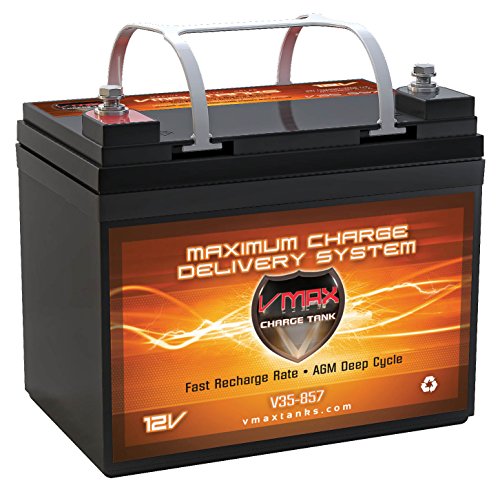
VMAXTANKS V35-857 12V 35Ah AGM battery
$109.94 Published specsA 35 Ah Group U1 case sized for a 30 lb thrust motor, with the maker's own published run times at three throttle settings.
Best for: Canoes, kayaks and small transom motors
Check price on AmazonBest all-around AGM deep cycle battery
Most 40 to 100 lb thrust trolling motor banks land here: a genuine deep cycle AGM in a common case size at a price that keeps lithium as a future upgrade rather than a requirement.
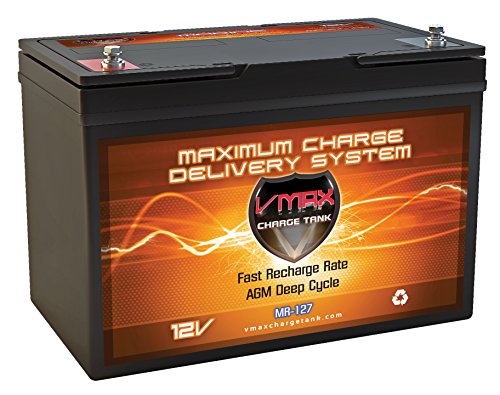
VMAX MR127 12V 100Ah AGM deep cycle battery
$259.96 Published specsThe AGM most commonly recommended for 40 to 100 lb motors, and its own listing states exactly that use case.
Best for: A conventional trolling motor bank on a budget
Check price on Amazon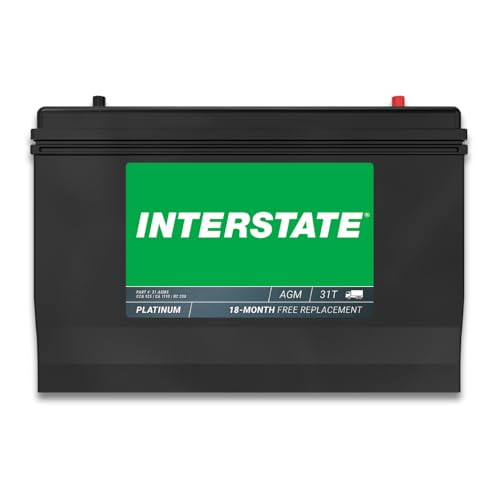
Interstate Batteries Marine and RV Group 31 AGM, 12V 100Ah
$284.95 Published specsA nationwide warranty counter is worth real money on a part that fails away from home.
Best for: Anyone who wants local warranty support over the lowest price
Check price on AmazonBest high performance AGM
Thin plate pure lead AGM closes most of the cycle life gap with lithium, at a price that only makes sense for a narrow group of buyers.

Odyssey ODX-AGM31 Extreme Series AGM battery
$518.99Thin plate pure lead construction competes with lithium on cycle life in a way no other AGM in this catalog does.
Best for: Tournament boats replacing AGM on a fixed schedule regardless of price
Check price on AmazonWho should not buy this tier: Anyone who would be better served putting the same money toward a lithium pack instead, which is most trolling motor buyers at this price point since lithium delivers more usable capacity at a lighter weight for a comparable cost.
How we chose
We did not test this equipment in person and we never claim to. Picks are researched from manufacturer specification sheets, published engineering and regulatory figures, and the recurring themes in verified owner reviews. Every pick is matched to a real thrust rating, a real published amp draw, a real capacity or a real conductor size rather than to a price bracket, and it is placed in the tier where its published capability actually belongs. We rejected the unbranded flood that dominates several of these search results, because a lithium pack whose management board is the only thing between a cell fault and a fire, a breaker protecting a battery cable, a life jacket and a bracket holding a two thousand dollar motor to the bow at highway speed are all parts whose failure has a consequence nobody can walk away from. Where a figure is convention rather than a published standard we label it that way, and where a manufacturer does not publish a figure we leave it out instead of estimating it.
Frequently asked questions
Why doesn't a 100 Ah AGM battery run a 50 amp trolling motor for two hours?
Simple division suggests two hours, but Peukert's equation, published battery engineering rather than a rule of thumb, shows that a lead acid battery delivers less of its rated capacity as the draw increases. At a 50 amp draw a 100 Ah AGM battery actually empties in roughly an hour and 25 minutes, and the 50 percent depth of discharge convention on top of that means recharging closer to 40 minutes protects the battery's cycle life.
What is the difference between Peukert's equation and the depth of discharge guideline?
Peukert's equation is published battery engineering describing how much capacity a battery physically delivers as discharge current rises. Depth of discharge is boating convention layered on top of that, built to protect how many charge cycles a battery has left rather than describing a physical limit. No standards body publishes a depth of discharge number, which is why lead acid uses 50 percent and lithium makers publish a higher usable figure for a different chemistry.
What is the difference between a dual purpose battery and a dedicated deep cycle battery?
A dual purpose battery, like the Mighty Max MM-G31M, is built to compromise between starting current and deep cycling so it can do both jobs adequately. A dedicated deep cycle battery gives up starting current entirely and is built only to be discharged and recharged repeatedly, which is the actual duty a trolling motor asks for. On a trolling motor bank specifically, a dedicated deep cycle battery in the same case size will generally outlast a dual purpose one.
Does group size, 24, 27 or 31, affect how long an AGM battery runs a motor?
Group size mainly describes the physical case and terminal layout, and it correlates with amp hours because a bigger case holds more lead, not because the number itself changes anything electrically. A Group 31 case generally carries more rated capacity than a Group 24 or 27 case from the same maker, so matching the tray already installed and then choosing the highest rated capacity that fits it is the right order of operations.
Is a thin plate pure lead AGM like the Odyssey worth the price over a standard AGM?
For most trolling motor buyers, no. Thin plate pure lead construction genuinely competes with lithium on cycle life, which is a real engineering difference from a standard AGM, but it costs close to what a comparable lithium pack costs while still weighing what lead acid weighs. The buyers it makes sense for are ones replacing batteries on a fixed maintenance schedule regardless of price, not anyone shopping on value.
Can an AGM battery be charged with the same charger as a lithium battery?
Not on the lithium profile, no. AGM tolerates a standard lead acid charge profile ending in absorption and float stages, while lithium needs a charger set to a lithium profile that stops differently and never holds the pack at that float voltage. A multi-bank charger with a selectable profile per bank can charge both chemistries correctly, but only if each bank is actually set for the battery sitting on it.
Get the complete rigging shopping list
Every item in the beginner, intermediate and expert rigs for both a boat and a kayak, with running totals, in one printable list. No charge.
One list, no sequence of daily emails, and you can leave at any time.
Researched, not professional advice. This page is compiled from published engineering and regulatory figures, manufacturer specifications and owner-review consensus, not hands-on testing. Figures described as a rule of thumb are boating convention rather than published standards, and they are labelled that way wherever they appear. Marine electrical work is not house wiring. Use tinned, finely stranded marine cable, size it for voltage drop and for the ABYC E-11 ampacity table rather than one or the other, and put overcurrent protection within seven inches of the battery positive terminal, because everything between the post and the fuse is unprotected. A lithium battery needs a charger with a lithium profile. Never load a boat past its capacity plate, and remember that canoes and kayaks carry no federal capacity plate at all, so their stated capacity is the manufacturer own figure. Wear the life jacket, and treat early season water as the hazard it is: cold water immersion takes your breath and then your hands long before it takes your core.