Transducers
Which transducer should you buy?
Quick answer
A transducer cone angle belongs to that transducer at its stated frequency, not to the display it plugs into. The Airmar P19 thru-hull publishes an 11 degree beam at 200 kHz and reads to 700 feet, while the Garmin GT56UHD-TM runs three frequencies from 455 kHz up to 1000 kHz on one transom mount body.
The screen only draws what the transducer hears. A newer, sharper display bolted onto an old transducer still shows an old, muddy picture, because the sonar frequency, beam width and imaging capability all live in the transducer itself, not in the head unit. Upgrading the transducer is frequently the better dollar for dollar move over upgrading the screen, and it is the upgrade most owners skip because it is less visible in a store.
Where a transducer physically mounts changes what it can do more than brand or price does. A transom mount bolts to the back of the boat and is the easiest to install and replace. A thru-hull means a hole cut below the waterline, and a plastic thru-hull housing belongs in fiberglass only, never in aluminium, where galvanic and structural issues make the fit wrong regardless of price. An in-hull, or shoot-thru, transducer glues to the inside of a solid fiberglass hull with no hole cut at all, at the cost of losing bottom temperature reading. Each of those is a real fit window, not an upgrade tier, and picking the wrong one for a given hull produces a transducer that never reads correctly no matter how good the screen is.
This roundup ranks transom mount transducers by frequency and imaging capability, then covers the thru-hull and in-hull options for boats where a transom mount is the wrong fit.
On this page
- How this list was put together
- Transom mount transducers by frequency
- Best transducer for a first upgrade
- Best transducer for most boats
- Best transducer for the sharpest picture
- Thru-hull and in-hull transducers, for boats a transom mount does not fit
- Fitting a transducer to a trolling motor or a kayak scupper
How this list was put together
This roundup is based on published manufacturer specifications and verified owner reviews, compared side by side across brands. The frequency, beam angle and depth figures below each trace back to a manufacturer listing, not an estimate written for this page.
Transom mount transducers by frequency
Every frequency and beam figure below comes from the manufacturer own listing.
The Garmin GT56UHD-TM transom mount transducer runs three frequencies from 455 kHz to 1000 kHz on a single transom body, the widest range in this group.
Published figure A published engineering, regulatory or manufacturer figure. It does not change because somebody disagrees with it.
| Transducer | Frequency | Imaging | Price |
|---|---|---|---|
| Humminbird XNT-9-20-T transom transducer with temperature | Dual beam CHIRP | None, sonar only | $92.95 |
| Garmin GT23M-TM transducer | 80 to 160 kHz mid CHIRP | ClearVu | $239.99 |
| Lowrance SplitShot Skimmer transducer | 455/800 kHz | DownScan | $85.99 |
| Garmin GT54UHD-TM transom mount transducer | 800 kHz UHD | ClearVu and SideVu | $396.71 |
| Humminbird XNT 9 HW MSI 150 T transom transducer | Dual Spectrum CHIRP | MEGA Side and Down Imaging | $189.06 |
| Garmin GT56UHD-TM transom mount transducer | 455, 800 and 1000 kHz UHD | ClearVu and SideVu | $468.83 |
Best transducer for a first upgrade
The stock transducer that ships with most entry level Helix and Striker units is a plain dual beam transom mount, and this is the direct replacement when one gets knocked off a trailer.

Humminbird XNT-9-20-T transom transducer with temperature
$92.95A dual beam transom transducer with a built in temperature sensor, compatible with nearly every non-DI Helix and Matrix head Humminbird has sold.
Best for: Replacing a damaged stock transducer without upgrading the head unit
Check price on AmazonBest transducer for most boats
An 800 kHz ultra high definition transducer is the point where ClearVu and SideVu start showing genuinely sharp structure rather than a soft outline.

Garmin GT54UHD-TM transom mount transducer
$396.71The transom transducer the seven inch ECHOMAP UHD2 units ship with, and a real jump over the 20 series transducers it replaces.
Best for: A boat with an ECHOMAP or Striker Vivid head that shipped with an older transducer
Check price on AmazonBest transducer for the sharpest picture
Three sonar frequencies on one housing, at 500 watts, is the ceiling for a transom mount transducer in this catalog.
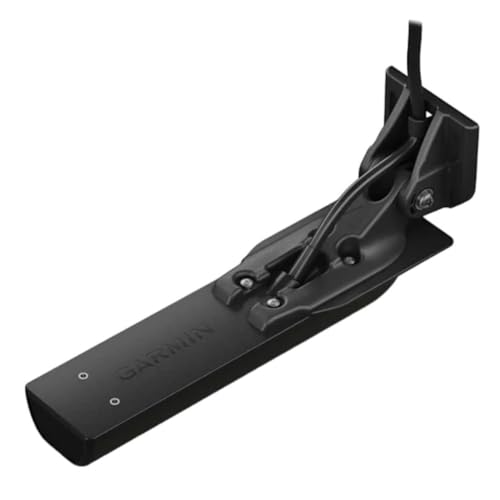
Garmin GT56UHD-TM transom mount transducer
$468.83455, 800 and 1000 kHz on one transducer, with a claimed 20 percent greater SideVu range at 1000 kHz over the 54 series it replaces.
Best for: A nine inch or larger ECHOMAP where the screen resolution can actually show the extra detail
Check price on AmazonWho should not buy this tier: A five or seven inch screen. The extra resolution the GT56UHD-TM produces is wasted on a smaller display, and the GT54UHD-TM already outperforms what a small screen can show.
Thru-hull and in-hull transducers, for boats a transom mount does not fit
A transom mount ventilates, meaning it sucks air and loses its signal, the moment a fast deep vee gets up on plane. A thru-hull transducer solves that by mounting through the hull itself, below the waterline, where it stays in solid water regardless of speed. The Garmin Airmar P19 is a plastic thru-hull built for fiberglass, at $161.59, and the plain Airmar P19 depth transducer is the same basic housing at 200 kHz and 350 watts for less money. A hull with real deadrise benefits from a tilted element like the 20 degree tilt on the Garmin Airmar B150M, which keeps the beam pointed straight down instead of angled off to one side.
An in-hull, or shoot-thru, transducer like the Lowrance shoot-thru-hull CHIRP transducer glues to the inside of a solid fiberglass hull with no hole cut at all. It only works through solid fiberglass with no balsa or foam core and no air gap, and it gives up the ability to read bottom temperature in exchange for zero holes below the waterline.
Fitting a transducer to a trolling motor or a kayak scupper
The Lowrance SplitShot Skimmer is built to mount four different ways on the same housing: transom, inside the hull, on a trolling motor shaft, or through a kayak scupper hole. That flexibility is exactly why it is a common starting transducer on a kayak, where nothing is meant to be permanently glued or bolted. A dedicated MEGA imaging transducer such as the Humminbird XNT 9 HW MSI is built specifically for a transom and expects a metal bracket rather than a scupper mount to hold its angle at speed.
How we chose
We did not test this equipment in person and we never claim to. Picks are researched from manufacturer specification sheets, published engineering and regulatory figures, and the recurring themes in verified owner reviews. Every pick is matched to a real thrust rating, a real published amp draw, a real capacity or a real conductor size rather than to a price bracket, and it is placed in the tier where its published capability actually belongs. We rejected the unbranded flood that dominates several of these search results, because a lithium pack whose management board is the only thing between a cell fault and a fire, a breaker protecting a battery cable, a life jacket and a bracket holding a two thousand dollar motor to the bow at highway speed are all parts whose failure has a consequence nobody can walk away from. Where a figure is convention rather than a published standard we label it that way, and where a manufacturer does not publish a figure we leave it out instead of estimating it.
Sources
- Garmin published specifications for the GT23M-TM, GT54UHD-TM, GT56UHD-TM and Airmar P19 and B150M transducers
- Airmar published specifications for the P19 thru-hull depth transducer
- Humminbird published specifications for the XNT 9 HW MSI and XNT-9-20-T transducers
- Lowrance published specifications for the SplitShot, TripleShot and shoot-thru-hull transducers
Frequently asked questions
Does cone angle depend on the display or the transducer?
The transducer. A cone or beam angle is a property of the physical transducer element at a given frequency, printed in its own spec sheet, and it does not change based on which screen it is plugged into. The Airmar P19 thru-hull depth transducer publishes an 11 degree beam regardless of whether it feeds a small portable unit or a large networked chartplotter.
Can a plastic thru-hull transducer go in an aluminium boat?
No. A plastic thru-hull housing such as the Garmin Airmar P19 plastic thru-hull transducer is built for fiberglass hulls only. Aluminium requires a bronze or specifically rated thru-hull housing for galvanic and structural reasons, not as a matter of preference. Mixing the wrong housing material with an aluminium hull creates a real corrosion and strength problem below the waterline.
Why does a transom mount transducer lose signal at speed?
A transom mount sits at the very back of a hull, in water disturbed by the propeller and the hull wake. On a fast deep vee, that disturbed water aerates, meaning it fills with air bubbles the sonar beam cannot read through cleanly, and the picture breaks up or drops out entirely. A thru-hull mounted below the waterline avoids that disturbed layer altogether.
What is the difference between a thru-hull and an in-hull transducer?
A thru-hull, like the Garmin Airmar P19 plastic thru-hull transducer, requires an actual hole cut through the hull below the waterline. An in-hull, or shoot-thru, transducer such as the Lowrance shoot-thru-hull CHIRP transducer glues to the inside of a solid fiberglass hull with no hole at all, at the cost of a slightly weaker signal and no bottom temperature reading.
Does a bigger, more expensive transducer always give a better picture?
Not automatically. A transducer needs to match the frequency and imaging modes the head unit actually supports, and it needs to fit the hull correctly. A GT56UHD-TM feeding a five inch screen does not outperform a matched GT54UHD-TM, because the smaller display cannot show the extra resolution either transducer is capable of producing.
Can one transducer mount on a trolling motor, a scupper and a transom?
Some can. The Lowrance SplitShot Skimmer transducer is designed for exactly that flexibility, mounting on a transom, inside the hull, on a trolling motor shaft, or through a kayak scupper on the same housing. A dedicated imaging transducer built for a metal transom bracket, like the Humminbird XNT 9 HW MSI 150 T transom transducer, is not designed for that kind of repositioning.
Get the complete rigging shopping list
Every item in the beginner, intermediate and expert rigs for both a boat and a kayak, with running totals, in one printable list. No charge.
One list, no sequence of daily emails, and you can leave at any time.
Researched, not professional advice. This page is compiled from published engineering and regulatory figures, manufacturer specifications and owner-review consensus, not hands-on testing. Figures described as a rule of thumb are boating convention rather than published standards, and they are labelled that way wherever they appear. Marine electrical work is not house wiring. Use tinned, finely stranded marine cable, size it for voltage drop and for the ABYC E-11 ampacity table rather than one or the other, and put overcurrent protection within seven inches of the battery positive terminal, because everything between the post and the fuse is unprotected. A lithium battery needs a charger with a lithium profile. Never load a boat past its capacity plate, and remember that canoes and kayaks carry no federal capacity plate at all, so their stated capacity is the manufacturer own figure. Wear the life jacket, and treat early season water as the hazard it is: cold water immersion takes your breath and then your hands long before it takes your core.