Trolling motor sizing
How much trolling motor thrust does a 600 lb boat need?
Quick answer
A 600 lb fully loaded boat needs at least 12 lb of thrust by the two pounds per hundred convention, and 30 lb if you fish wind or current. The practical figure most people land on is around 18 lb, which points at a 30 lb motor on a 12 volt system, which means 1 battery.
Thrust sizing is one rule of thumb and one consequence. The rule is two pounds of thrust per hundred pounds of fully loaded boat, and nobody publishes it: it is convention, it assumes flat water and no wind, and it is a floor rather than a target.
The consequence is the one that costs money. Thrust above 55 lb means 24 volts, and above 80 lb means 36 volts, so the thrust decision is really a decision about how many batteries live in the boat permanently. On a 600 lb boat that is the number worth thinking about before the motor.
On this page
What 600 lb needs at each condition
A 600 lb boat needs 12 lb of thrust in sheltered water and 30 lb for wind and current.
Rule of thumb Boating and fishing convention rather than a published standard. Taught everywhere, useful, and not a specification. Nothing enforces it and no body publishes it.
| Conditions | Rule | Thrust needed | Smallest stocked motor |
|---|---|---|---|
| Sheltered, little wind | 2 lb per 100 lb | 12 lb | 30 lb at 12V |
| Normal lake conditions | 3 lb per 100 lb | 18 lb | 30 lb at 12V |
| Wind, current or big water | 5 lb per 100 lb | 30 lb | 30 lb at 12V |
Fully loaded means hull, outboard, batteries, fuel, gear and people. A boat weighed empty on a trailer is not the number this calculation wants.
What that thrust costs in batteries
This is the part the thrust number hides. A motor voltage is not a preference, it is how many batteries sit in the boat for good.
The motor this boat points at runs on 12 volts, which is 1 battery.
Published figure A published engineering, regulatory or manufacturer figure. It does not change because somebody disagrees with it.
| Thrust | System voltage | Batteries | Published maximum draw |
|---|---|---|---|
| 30 lb | 12 V | 1 | 30 A |
| 40 lb | 12 V | 1 | 42 A |
| 45 lb | 12 V | 1 | 42 A |
| 50 lb | 12 V | 1 | 42 A |
| 55 lb | 12 V | 1 | 50 A |
| 70 lb | 24 V | 2 | 42 A |
| 80 lb | 24 V | 2 | 56 A |
| 101 lb | 36 V | 3 | 46 A |
| 112 lb | 36 V | 3 | 52 A |
The maximum draw figures are the commonly published manufacturer values at maximum thrust. Check the figure in the manual for your own motor before sizing a breaker or a cable from it.
Thrust is not horsepower and does not convert to it
A thrust rating is a static bollard pull figure measured at full power in a tank. It tells you how hard the motor pushes against a rope, not how fast it will move your hull. Two motors of the same thrust can move the same boat differently depending on prop, shaft length and how the hull sits in the water, and none of that appears in the number on the box.
What thrust is genuinely good for is comparing motors to each other and applying the convention above. Beyond that, the honest advice on a 600 lb boat is that nobody has ever regretted buying slightly more thrust, and plenty of people have spent a windy afternoon at full power wishing they had.
Shaft length matters as much as thrust
The commonest complaint about a correctly sized motor is that the prop ventilates when the bow lifts. That is a shaft length problem, not a thrust problem. Measure from the mounting surface on the bow deck down to the waterline, then add 16 inches for sheltered water or 20 for rough, and round up to a stocked length. A motor with the right thrust and a short shaft is a motor you will fight with all season.
Motors rated at or above 18 lb of thrust
Chosen against the numbers on this page rather than from a general list, so the recommendation cannot contradict the arithmetic above. Every figure quoted is the manufacturer own published specification.
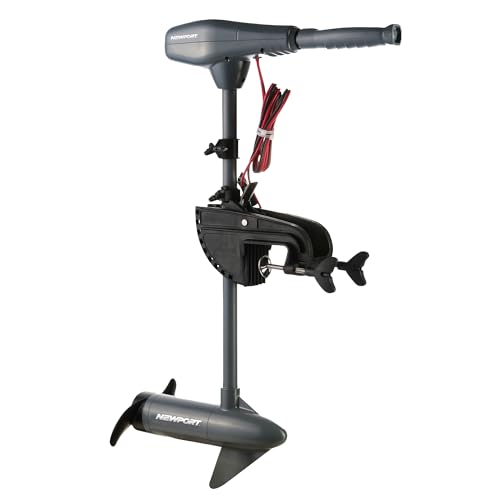
Newport Kayak Series 36 lb thrust, 24 inch shaft
$169.99 Published specsA 24 inch shaft, which is the length a kayak transom actually needs and the reason a boat motor looks wrong on one.
Best for: Kayaks and small inflatables where a 30 inch shaft is too long
Check price on Amazon
Newport NV-Series 46 lb thrust
$214.99 Published specsThe middle Newport, and the size that suits a loaded two person inflatable or a small skiff.
Check price on Amazon Newport NV-Series 55 lb thrust saltwater
$239.99 Published specsFifty five pounds of salt rated thrust for a quarter of what the equivalent Minn Kota costs, and the trade is the warranty and the parts network.
Check price on Amazon Newport Kayak Series 55 lb thrust, 24 inch shaft
$239.99 Published specsConsiderably more thrust than a kayak needs in calm water, which is exactly the point on a tidal river.
Check price on Amazon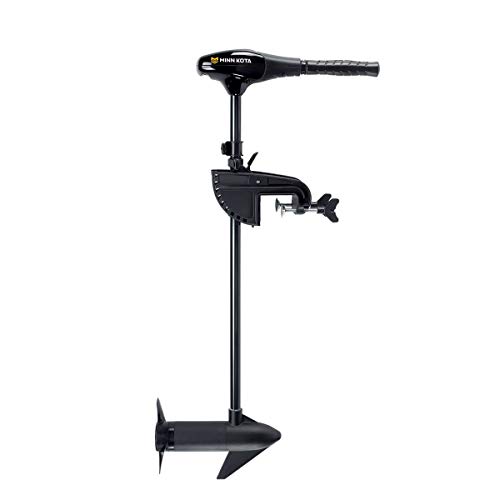
Minn Kota Endura C2 40, 36 inch shaft
$259.99 Published specsThe simplest motor Minn Kota sells and the one that outlives everything: five forward speeds, a mechanical switch and nothing to go wrong.
Best for: A jon boat, a canoe or a small aluminium boat on one battery
Check price on Amazon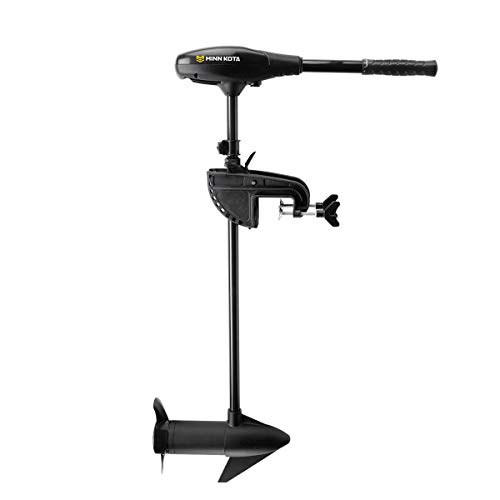
Minn Kota Endura Max 45, 36 inch shaft
$279.99 Published specsDigital Maximizer gives variable speed instead of five fixed steps, which genuinely extends run time at the low settings people actually troll at.
Check price on AmazonHow we chose
We did not test this equipment in person and we never claim to. Picks are researched from manufacturer specification sheets, published engineering and regulatory figures, and the recurring themes in verified owner reviews. Every pick is matched to a real thrust rating, a real published amp draw, a real capacity or a real conductor size rather than to a price bracket, and it is placed in the tier where its published capability actually belongs. We rejected the unbranded flood that dominates several of these search results, because a lithium pack whose management board is the only thing between a cell fault and a fire, a breaker protecting a battery cable, a life jacket and a bracket holding a two thousand dollar motor to the bow at highway speed are all parts whose failure has a consequence nobody can walk away from. Where a figure is convention rather than a published standard we label it that way, and where a manufacturer does not publish a figure we leave it out instead of estimating it.
Frequently asked questions
How much thrust does a 600 lb boat need?
At the usual two pounds of thrust per hundred pounds of fully loaded boat, a 600 lb boat needs about 12 lb of thrust. That figure assumes flat water and no wind, so it is a floor rather than a target. For wind, current or open water the figure people actually use is five pounds per hundred, which comes to 30 lb. Both numbers are boating convention rather than any published standard.
Is the boat weight the empty weight or the loaded weight?
Loaded, and it is the difference between a motor that works and one that does not. Fully loaded means the hull, the outboard, every battery, a full fuel tank, all the gear and everybody aboard. A boat that weighs 360 lb empty on a trailer can easily reach 600 lb by the time it leaves the ramp, and the thrust calculation wants the second number.
What system voltage does that thrust need?
The 30 lb motor this points at runs on 12 volts, which means 1 battery permanently in the boat. Twelve volt motors stop at 55 lb of thrust, 24 volt motors cover 70 and 80 lb, and 36 volts starts at 101 lb. The voltage decision is really a decision about weight and cost, because lead acid batteries run roughly 60 lb each.
Will more thrust drain the battery faster?
Only if you use it. Current draw follows how hard you are working the motor rather than its rating, so a larger motor loafing at a low setting frequently draws less than a small motor held near full power all afternoon. That is the real argument for buying above the minimum: the bigger motor spends most of the day doing easy work, which is both quieter and easier on the battery.
Bow mount or transom mount for this size of boat?
Transom mounts are far cheaper and are the right answer on a jon boat, a canoe or an inflatable, where you are steering with a tiller anyway. A bow mount pulls the boat rather than pushing it, which tracks better in wind, and it frees your hands through a foot pedal or a remote. Almost everybody who fishes seriously from a boat ends up on the bow eventually.
Does the thrust rule change in saltwater?
The arithmetic does not, but the conditions usually do. Tide and current mean you should size from the five pounds per hundred figure rather than the two, which puts this boat at 30 lb rather than 12 lb. What genuinely changes is the build: a salt rated motor has the anodes and sealed hardware that decide whether it survives a second season, and a freshwater motor in salt is a short story.
Get the complete rigging shopping list
Every item in the beginner, intermediate and expert rigs for both a boat and a kayak, with running totals, in one printable list. No charge.
One list, no sequence of daily emails, and you can leave at any time.
Researched, not professional advice. This page is compiled from published engineering and regulatory figures, manufacturer specifications and owner-review consensus, not hands-on testing. Figures described as a rule of thumb are boating convention rather than published standards, and they are labelled that way wherever they appear. Marine electrical work is not house wiring. Use tinned, finely stranded marine cable, size it for voltage drop and for the ABYC E-11 ampacity table rather than one or the other, and put overcurrent protection within seven inches of the battery positive terminal, because everything between the post and the fuse is unprotected. A lithium battery needs a charger with a lithium profile. Never load a boat past its capacity plate, and remember that canoes and kayaks carry no federal capacity plate at all, so their stated capacity is the manufacturer own figure. Wear the life jacket, and treat early season water as the hazard it is: cold water immersion takes your breath and then your hands long before it takes your core.