Power
How do you switch a trolling motor bank to lithium?
Quick answer
Switching a bank to lithium changes more than the battery: a lithium battery needs a charger with a lithium profile, because a lead acid profile either never reaches the voltage a LiFePO4 pack needs or holds it at a float voltage it should not sit at, and that charger is part of the real cost of switching.
Lithium is the single biggest weight and capacity upgrade available to a trolling motor bank, and it is not a drop-in replacement. A LiFePO4 pack behaves differently enough from lead acid, in how it discharges, how it charges and how it has to be protected from cold, that treating the swap as just a heavier price tag on the same battery is how people damage an expensive purchase in the first season.
The single rule that matters more than any other: a lithium battery needs a charger with a lithium profile. A lead acid charging profile either never reaches the bulk voltage a LiFePO4 pack needs to fill, or it holds the pack at an absorption and float voltage lithium should not sit at long term. The charger is part of the cost of switching, not an accessory to buy later.
What follows covers the two kinds of numbers that actually change with the chemistry switch, published Peukert engineering and the depth of discharge convention, kept in separate tables because they are not the same kind of figure, plus the mixing mistakes and cold weather rule that cause most of the lithium failures reported on the water.
On this page
- Why does a lithium battery deliver more of its rated capacity?
- How much of the rated capacity can you actually use?
- How do you switch a bank to lithium step by step?
- Which onboard chargers carry a genuine lithium profile?
- Which lithium batteries fit a 12, 24 or 36 volt bank?
- What should you never do with a lithium bank?
Why does a lithium battery deliver more of its rated capacity?
Peukert's equation describes how a battery's delivered capacity falls as the discharge current rises, and it is published battery engineering rather than an opinion about one brand or another. The exponent is chemistry dependent, and the gap between lead acid and LiFePO4 is the single biggest practical difference on a trolling motor bank.
LiFePO4's exponent of 1.02 versus AGM's 1.15 is why a lithium pack delivers close to its full rated capacity at a hard trolling motor draw, while a lead acid battery does not come close.
Published figure A published engineering, regulatory or manufacturer figure. It does not change because somebody disagrees with it.
| Chemistry | Peukert exponent (published) |
|---|---|
| Flooded lead acid | 1.25 |
| AGM lead acid | 1.15 |
| Gel lead acid | 1.20 |
| LiFePO4 lithium | 1.02 |
A higher exponent means delivered capacity falls faster as current rises. LiFePO4 sitting near 1.0 is why its rated amp hours hold up at a 50 amp motor draw far better than a lead acid battery of the same rating.
How much of the rated capacity can you actually use?
Depth of discharge is a different kind of number from Peukert. Nobody publishes it as an engineering standard; it is convention the lead acid world settled on to protect cycle life, and lithium makers publish a usable depth directly instead.
The 50 percent depth of discharge guideline on lead acid is convention, not a published standard, and it is the reason a 100 Ah lead acid battery and a 100 Ah lithium battery are not the same purchase.
Rule of thumb Boating and fishing convention rather than a published standard. Taught everywhere, useful, and not a specification. Nothing enforces it and no body publishes it.
| Chemistry | Depth of discharge guideline |
|---|---|
| Flooded lead acid | 50% |
| AGM lead acid | 50% |
| Gel lead acid | 50% |
| LiFePO4 lithium | 80% |
Lead acid cycle life falls off sharply past roughly 50 percent depth of discharge, which is why the guideline exists even without a standards body behind it. LiFePO4 tolerates far deeper cycling, and 80 percent is the conservative planning figure most makers publish.
How do you switch a bank to lithium step by step?
- Size the pack by usable amp hours, not rated amp hours. Work out how many amp hours you actually use per trip, then divide by the depth of discharge guideline for the chemistry to find the rated capacity you need. A 50 Ah LiFePO4 pack at 80 percent depth of discharge delivers more usable capacity than its rated number alone suggests.
- Buy a charger with a lithium profile before the battery arrives. Confirm the charger has a selectable lithium or LiFePO4 mode. Several onboard chargers, including the Minn Kota PCL series and select ProMariner ProSport HD models, carry one; plenty of older and cheaper chargers do not.
- Never mix chemistries or ages in one bank. A lithium battery paired with a lead acid battery in the same bank, or two lithium packs of different ages wired together, charge and discharge unevenly and can damage both. Replace a bank as a matched set.
- Check the cold weather charging cutoff. LiFePO4 must not be charged below freezing without a battery management board that specifically handles it. Most consumer packs include low temperature charge cutoff protection; confirm yours does before an early season trip.
- Fit the correct fuse or breaker within reach of the battery post. Overcurrent protection still goes within about 7 inches of the battery positive terminal under ABYC E-11, extended to 40 inches inside a sheath, regardless of chemistry. Nothing about switching to lithium changes this rule.
- Test the new bank under load before trusting it. Run the motor at a working draw and watch the voltage rather than assuming a fresh lithium pack is fine because it reads full at rest. A clamp meter on the feed cable confirms the draw matches what the motor's own manual publishes.
Which onboard chargers carry a genuine lithium profile?

Minn Kota MK-220PCL onboard charger, 2 banks 10 amps
$242.57 Published specsThe PCL series adds a selectable LiFePO4 profile alongside AGM, flooded and gel on a two bank charger.
Best for: A 24 volt lithium bank on a Minn Kota boat
Check price on Amazon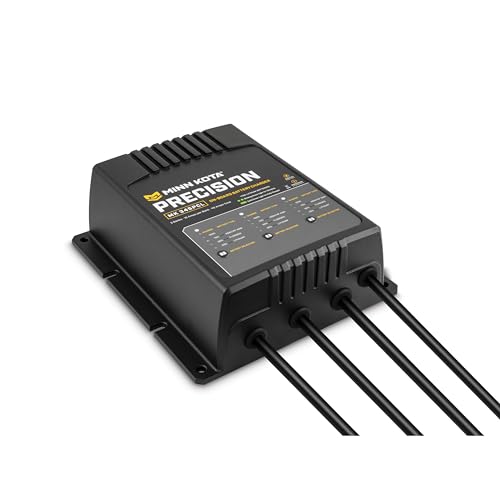
Minn Kota MK-345PCL onboard charger, 3 banks 15 amps
$372.02 Published specsFifteen amps per bank with a lithium profile, the fastest genuine three bank lithium charge in this catalog.
Best for: A 36 volt lithium motor bank
Check price on Amazon
ProMariner ProSport HD 8A 2-bank waterproof onboard charger
$154.85 Published specsWaterproof rather than water resistant, with a selectable LiFePO4 profile, for a charger that lives somewhere that gets wet.
Best for: A compact two bank lithium setup in an exposed compartment
Check price on AmazonWhich lithium batteries fit a 12, 24 or 36 volt bank?
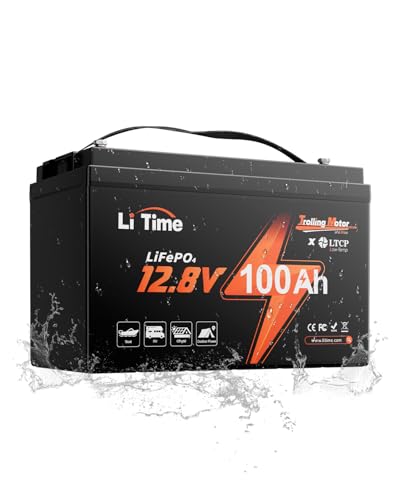
LiTime 12V 100Ah trolling motor LiFePO4 battery
$335.99 Published specsBuilt specifically for the sustained high discharge a trolling motor asks for, at a fraction of the weight of the AGM it replaces.
Best for: A 12 volt motor on a boat that fishes full days
Check price on Amazon
LiTime 24V 100Ah Bluetooth LiFePO4 battery
$499.99 Published specsReplaces a series pair of 12 volt lead acid batteries with one pack and one BMS instead of two batteries ageing unevenly.
Best for: A 24 volt bank swap
Check price on Amazon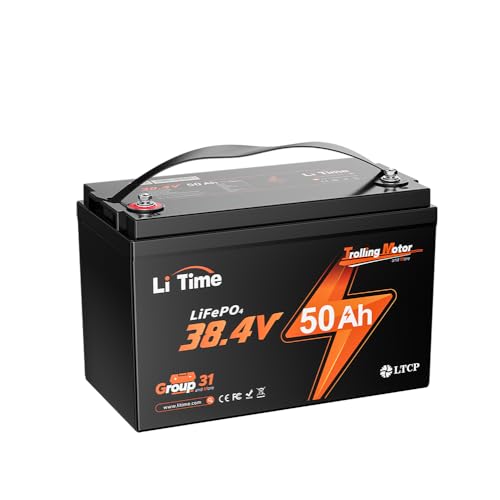
LiTime 36V 50Ah TM LiFePO4 battery with low temperature protection
$439.99 Published specsFifty rated amp hours of LiFePO4 delivers close to what three lead acid batteries did, at roughly a third of the weight.
Best for: A 36 volt bank where weight is the reason for switching
Check price on AmazonWhat should you never do with a lithium bank?
Never mix a lithium battery into a bank with lead acid, and never wire two lithium packs of different ages or cycle counts together. Each chemistry, and each pack's own state of wear, charges and discharges on a different curve, and forcing them to share a circuit means one battery ends up working the other's share of the load.
Do not assume the old battery box and hold-down strap are fine as-is. They usually are, because a LiFePO4 pack is lighter and the same physical hold-down standard applies regardless of chemistry, but confirm the new pack's dimensions against the box before ordering, since a lithium case is not always shaped like the lead acid battery it replaces. A shunt based monitor, rather than reading voltage alone, is worth adding at the same time, because lithium holds a flat voltage across most of its usable range and voltage alone stops being a useful state of charge indicator the way it is on lead acid.
How we chose
We did not test this equipment in person and we never claim to. Picks are researched from manufacturer specification sheets, published engineering and regulatory figures, and the recurring themes in verified owner reviews. Every pick is matched to a real thrust rating, a real published amp draw, a real capacity or a real conductor size rather than to a price bracket, and it is placed in the tier where its published capability actually belongs. We rejected the unbranded flood that dominates several of these search results, because a lithium pack whose management board is the only thing between a cell fault and a fire, a breaker protecting a battery cable, a life jacket and a bracket holding a two thousand dollar motor to the bow at highway speed are all parts whose failure has a consequence nobody can walk away from. Where a figure is convention rather than a published standard we label it that way, and where a manufacturer does not publish a figure we leave it out instead of estimating it.
Frequently asked questions
Can I use my old lead acid charger on a new lithium battery?
Not safely, in most cases. A lead acid charging profile either never reaches the bulk voltage a LiFePO4 pack needs to fill, or it holds the pack at an absorption and float voltage lithium should not sit at for long periods. Check whether your existing charger has a selectable lithium or LiFePO4 profile before assuming it will work, and budget for a replacement if it does not.
Can I mix a lithium battery with lead acid batteries in the same bank?
No. Different chemistries charge and discharge on different curves, so wiring them together means one battery ends up compensating for the other rather than sharing the load evenly. This shortens the life of both and, in a series bank, can leave the group at an unpredictable combined voltage. Replace a bank as a matched set of the same chemistry and age.
Is 50 Ah of lithium really enough to replace three lead acid batteries?
Often, yes, because two effects work in the same direction: LiFePO4's Peukert exponent near 1.02 delivers close to its full rated capacity at a hard motor draw, and its 80 percent depth of discharge guideline releases far more of that capacity than lead acid's 50 percent convention allows. Work the actual run time sum for your motor and hours on the water before assuming more capacity is needed.
Can I charge a lithium trolling motor battery in freezing weather?
Not without a battery management system built to handle it. LiFePO4 cells should not be charged below freezing, and most consumer packs include a low temperature charge cutoff that pauses charging automatically rather than damaging the cells. Confirm your specific battery's published cold weather cutoff before an early season or ice fishing trip.
Does switching to lithium change how I size the overcurrent protection?
The placement rule does not change: overcurrent protection still goes within about 7 inches of the battery positive terminal under ABYC E-11, extended to 40 inches inside a sheath, regardless of chemistry. The breaker or fuse size itself is set by the continuous current the motor draws, which a lithium switch does not usually change on its own.
How do I know how much charge is left in a lithium battery?
Voltage alone is a poor indicator on LiFePO4, because the pack holds a flat voltage across most of its usable range and only drops sharply near empty. A Bluetooth enabled battery or a separate shunt based monitor that counts amp hours in and out gives a far more honest state of charge than reading voltage the way you would on lead acid.
Get the complete rigging shopping list
Every item in the beginner, intermediate and expert rigs for both a boat and a kayak, with running totals, in one printable list. No charge.
One list, no sequence of daily emails, and you can leave at any time.
Researched, not professional advice. This page is compiled from published engineering and regulatory figures, manufacturer specifications and owner-review consensus, not hands-on testing. Figures described as a rule of thumb are boating convention rather than published standards, and they are labelled that way wherever they appear. Marine electrical work is not house wiring. Use tinned, finely stranded marine cable, size it for voltage drop and for the ABYC E-11 ampacity table rather than one or the other, and put overcurrent protection within seven inches of the battery positive terminal, because everything between the post and the fuse is unprotected. A lithium battery needs a charger with a lithium profile. Never load a boat past its capacity plate, and remember that canoes and kayaks carry no federal capacity plate at all, so their stated capacity is the manufacturer own figure. Wear the life jacket, and treat early season water as the hazard it is: cold water immersion takes your breath and then your hands long before it takes your core.