Trolling motors
Bow mount or transom mount: which trolling motor fits your boat?
Quick answer
A bow mount trolling motor pulls the boat, tracks straighter in wind, and frees your hands through a foot pedal or remote, while a transom mount costs roughly a fifth as much. Buy a bow mount for a boat with a bow rail, and a transom mount for a jon boat, canoe or inflatable with none.

Minn Kota Terrova 55 with GPS and Spot-Lock, 54 inch shaft
$1,649.99 Published specsPulls the boat from the bow, steers by foot pedal or remote, and holds position with Spot-Lock GPS anchoring
Best for: The buy-once bow motor for a single battery freshwater boat
Check price on Amazon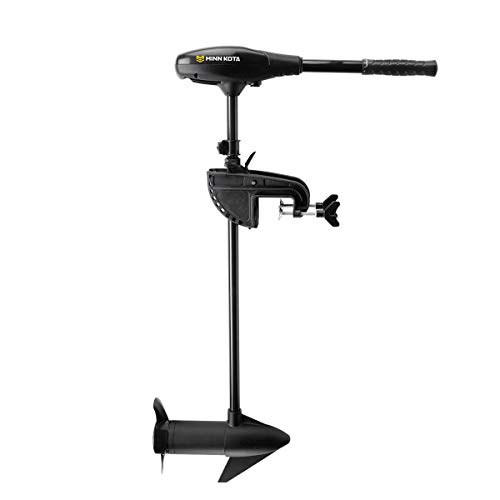
Minn Kota Endura Max 55, 42 inch shaft
$329.99 Published specsClamps to the transom, steers by hand on a tiller, and costs a fraction of the bow mount price at the same 55 lb thrust
Check price on AmazonA bow mount motor is the better choice for nearly any boat with a bow rail to mount one on, because it pulls the hull through the water instead of pushing it, which tracks straighter in wind and current and frees both hands to fish through a foot pedal or a handheld remote. A transom mount tiller motor gives up that hands-free control and that wind tracking, and in exchange it costs a fraction of the price, bolts on in minutes with no deck wiring, and is the only sensible answer on a boat with no bow to speak of.
The two are not really competing for the same buyer. A bass boat, a bay boat or a pontoon with a flat bow deck is built around a bow mount motor, and retrofitting a transom motor onto one would be a downgrade in control for no real savings once the boat is already rigged for it. A jon boat, a canoe, a kayak or a small inflatable rarely has anywhere flat and stable enough at the bow to mount one at all, and a transom clamp is both cheaper and the only mount that actually fits.
Thrust class and system voltage matter more than the mount style once you have picked one, and that is a separate decision covered in the 12V vs 24V vs 36V comparison.
On this page
- What is the actual difference between a bow mount and a transom mount motor
- What each one actually costs
- Control: a foot pedal frees your hands, a tiller does not
- When a transom mount is the right and cheaper answer
- Can you retrofit a bow mount onto a boat that was not built for one
- Which one should you actually buy
What is the actual difference between a bow mount and a transom mount motor
A bow mount trolling motor bolts to the front deck and pulls the boat through the water, steered by a foot pedal, a handheld remote or both. A transom mount trolling motor clamps to the back of the boat next to or below the outboard and pushes it, steered by hand on a tiller arm exactly like a small outboard. Pulling from the front tracks straighter in wind and current because the hull follows the bow rather than getting shoved sideways from behind, and it is the reason nearly every dedicated bass or bay boat runs a bow mount rather than a transom motor as its primary trolling power.
What each one actually costs
Compare two real motors at the same 55 lb thrust class, one of each mount style, and the price gap is not small.
At the same 55 lb thrust rating, the bow mount Terrova 55 lists for roughly $1,650 and the transom mount Endura Max 55 lists for roughly $330, a five times price difference before batteries or a foot pedal are added.
Published figure A published engineering, regulatory or manufacturer figure. It does not change because somebody disagrees with it.
| Motor | Mount | Volts | Max published draw | Control |
|---|---|---|---|---|
| Minn Kota Terrova 55 | Bow | 12 | 50 A | Foot pedal or wireless remote |
| Minn Kota Endura Max 55 | Transom | 12 | 50 A | Hand tiller |
Prices are the catalog listing at the time this page was written and change with the market. Both motors draw the same published maximum current at this thrust and voltage.
Control: a foot pedal frees your hands, a tiller does not
A bow mount motor paired with a foot pedal, such as the one built into the Terrova 80, steers with your feet while both hands stay on the rod, which matters most when working a shoreline or a piece of structure that needs constant small course corrections. A transom tiller motor needs one hand on the tiller arm to steer, which is a real limitation for a single angler fishing alone and far less of one for two people sharing the boat, where whoever is not casting can run the tiller.
When a transom mount is the right and cheaper answer
A jon boat, a canoe or a small aluminum boat under about 14 feet is the classic transom mount case: there is no flat bow deck to bolt a bracket to, the boat is light enough that a modest thrust motor is plenty, and the lower purchase price matters more on a boat that is not carrying a live sonar unit and a bank of lithium batteries already. The Endura C2 40 is the simplest version of this idea, a mechanical five speed motor with nothing electronic to fail. An inflatable or a small skiff running in salt does the same math with a saltwater rated transom motor such as the Newport NV-Series 55 instead of paying bow mount money for a feature the hull cannot really use.
Can you retrofit a bow mount onto a boat that was not built for one
Sometimes, if the bow deck is flat, stable and rated to carry the weight of the motor and its mounting bracket, such as the MKA-21 quick release bracket. A boat with a rounded or narrow bow, or one with no deck at all forward of the windshield, is not a retrofit candidate, and forcing a bow mount onto a hull that was not designed for one is a stability and mounting strength problem before it is anything else. Check the deck construction and consult the boat's own manual before assuming a bow mount will bolt on.
Which one should you actually buy
Buy a bow mount if the boat already has a bow deck built for one, if you fish alone and need both hands free, or if the water you fish is regularly windy enough that pushing from behind means constantly fighting the bow off line. Buy a transom mount if the boat has no bow to speak of, if the budget has to cover sonar and safety gear too, or if the boat already runs fine with one person on the tiller and one person casting.
Frequently asked questions
Does a bow mount trolling motor add much weight to the front of the boat?
Yes, and it is weight that stays there permanently. A bow mount motor itself typically runs 40 to 60 lb depending on shaft length and features, and the battery or batteries feeding a 12, 24 or 36 volt system add considerably more on top of that. Account for the full installed weight, not just the motor's own figure, against the boat's capacity plate before buying.
Can I put a bow mount trolling motor on a canoe or kayak?
Some kayaks and canoes can carry a bow mount built specifically for that hull type, such as a 36 inch shaft kayak bow motor, but a standard boat bow motor with a 54 or 60 inch shaft and a foot pedal is the wrong product for a kayak's deck layout and weight budget. Check a motor's specific mount type and shaft length against the kayak maker's own accessory guidance first.
Is a transom mount motor strong enough for a bigger boat?
Transom mount motors top out lower than bow mount motors, generally in the 30 to 62 lb thrust range on 12 volts, which covers a jon boat, canoe or small aluminum boat but runs out of headroom on a boat heavy enough to need a 24 or 36 volt system. A boat that size is better served by a bow mount motor at the higher thrust and voltage classes that transom motors do not reach.
Do I need a foot pedal with a bow mount motor, or can I steer it by hand?
Many bow mount motors ship with or support a foot pedal, and it is the point of buying one over a transom motor for most anglers. Some bow motors are also available with hand steering or remote-only control instead of a pedal, so check the specific motor's control options before assuming a pedal is included, since it changes both the price and how the boat is fished.
Which one is quieter for approaching fish in shallow water?
Both are electric and considerably quieter than a gas outboard, and neither one is silent while actually driving the boat. A bow mount running on Spot-Lock at low speed to hold position is generally quieter and less disruptive than a transom motor working the same job from behind, mainly because the prop sits ahead of the hull instead of churning water directly behind the angler.
Can I run both a bow mount and a transom mount motor on the same boat?
Yes, and it is a common setup on boats that troll long distances between spots. The transom motor, or the outboard itself at idle, covers the longer moves, while the bow mount motor takes over for the fine positioning work once you are on a spot. The two systems typically run on separate batteries rather than sharing one bank.
Get the complete rigging shopping list
Every item in the beginner, intermediate and expert rigs for both a boat and a kayak, with running totals, in one printable list. No charge.
One list, no sequence of daily emails, and you can leave at any time.
Researched, not professional advice. This page is compiled from published engineering and regulatory figures, manufacturer specifications and owner-review consensus, not hands-on testing. Figures described as a rule of thumb are boating convention rather than published standards, and they are labelled that way wherever they appear. Marine electrical work is not house wiring. Use tinned, finely stranded marine cable, size it for voltage drop and for the ABYC E-11 ampacity table rather than one or the other, and put overcurrent protection within seven inches of the battery positive terminal, because everything between the post and the fuse is unprotected. A lithium battery needs a charger with a lithium profile. Never load a boat past its capacity plate, and remember that canoes and kayaks carry no federal capacity plate at all, so their stated capacity is the manufacturer own figure. Wear the life jacket, and treat early season water as the hazard it is: cold water immersion takes your breath and then your hands long before it takes your core.