Portable sonar
Which castable fish finder should you buy?
Quick answer
The Deeper PRO Plus 2 reads to 330 feet and builds its own map from the bank, which makes it the castable fish finder worth the extra money. On a tighter budget, the Garmin Striker Cast with GPS streams sonar to a phone from 200 feet away and saves waypoints on the same cast for $199.99.
A castable fish finder is a sonar ball you throw on a line, not a screen bolted to a boat. It talks to a phone or tablet over its own Wi-Fi signal, which means the "display" is whatever is already in a pocket. That trade buys real sonar for a bank angler, a dock, a rental boat or a kayak where nothing is going to be drilled, at a fraction of the price of a transom unit.
The catch is range and battery. A castable ball talks to a phone over a short wireless link, not a wired transducer cable, so the published range in feet is the real spec that separates these units, not screen size or button layout. A phone screen in direct sun is also a harder read than a dedicated fish finder display, so a unit worth buying earns that compromise with genuine sonar rather than a gimmick.
This roundup covers four castable units built around the same idea with different range, mapping and price. Every figure below is the maker's own published spec, not a number estimated for this page.
On this page
- How this list was put together
- What does a castable fish finder actually do?
- Castable range and mapping, compared
- Best castable fish finder for a first purchase
- Best castable fish finder for most anglers
- Best castable fish finder for serious range
- Does a castable fish finder work as well as a boat mounted one?
How this list was put together
This roundup is built from published manufacturer specifications and verified owner reviews, compared side by side. Nobody on this site claims to have thrown every ball in this list off a dock before writing about it; the range, beam and battery numbers below are the manufacturer's own, and the durability notes come from patterns across verified owner reviews.
What does a castable fish finder actually do?
A castable fish finder is a waterproof sonar transducer sealed inside a ball, with no cable. It floats or sinks depending on the mode, streams a sonar return over its own Wi-Fi hotspot to an app, and the app draws the screen a wired unit would otherwise show on a console. Range is capped by that wireless link rather than by depth, so a unit rated to 165 feet stops working at 165 feet of horizontal distance from the phone even in water twice that deep.
The two things that separate a good one from a toy are published range in feet and whether it carries its own GPS. A unit with GPS can log a scan against a real position and rebuild it later as a contour map, which is the entire pitch of fishing the same farm pond or stretch of bank across a season.
Castable range and mapping, compared
Every figure below comes from the product listing, not a measurement taken for this page.
The Deeper PRO Plus 2 Smart Sonar publishes the longest range of this group at 330 feet, with onshore mapping built in.
Published figure A published engineering, regulatory or manufacturer figure. It does not change because somebody disagrees with it.
| Unit | Published range | GPS mapping | Price |
|---|---|---|---|
| Deeper START Smart Fish Finder | 165 ft | No | $89.99 |
| Garmin Striker Cast | 200 ft | No | $149.99 |
| Garmin Striker Cast with GPS | 200 ft | Yes, Quickdraw Contours | $199.99 |
| Deeper PRO Plus 2 Smart Sonar | 330 ft | Yes, onshore mapping | $159.99 |
Range is the wireless link between the ball and the phone, not the maximum depth the sonar can read.
Best castable fish finder for a first purchase
The goal here is a real depth and structure read for the least money, without paying for a mapping feature that goes unused.

Deeper START Smart Fish Finder
$89.99A 40 degree beam and a 165 foot range for under a hundred dollars, with no wires and no external battery to manage.
Best for: Bank fishing, dock fishing and family trips where a phone is already in a pocket
Check price on AmazonBest castable fish finder for most anglers
Adding GPS to the same basic idea turns a single scan into a map that can be revisited, which is the upgrade most owners say they wish they had bought first.

Garmin Striker Cast with GPS
$199.99Quickdraw Contours turns a retrieve into a one foot contour map of water nobody else has charted, and the non-GPS {{p:garmin-striker-cast|Garmin Striker Cast}} costs fifty dollars less if that feature is not needed.
Best for: A kayak angler or bank angler who fishes the same water repeatedly
Check price on AmazonBest castable fish finder for serious range
The Deeper PRO Plus 2 is built for someone who wants to build a real bathymetric map of a piece of water from the bank, not just check what is under the ball right now.
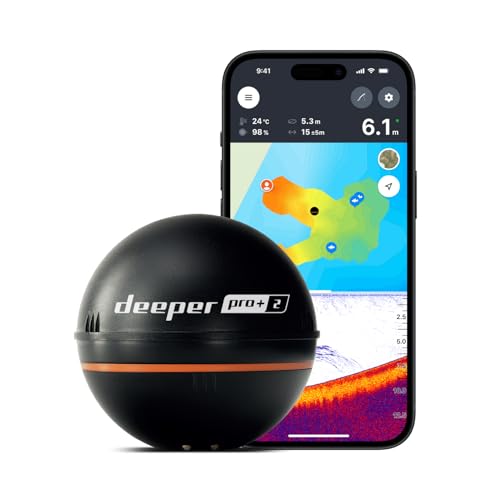
Deeper PRO Plus 2 Smart Sonar
$159.99Three beam widths, a 330 foot range and onshore GPS mapping saved to an app, which is a genuinely different tool than a single narrow beam ball.
Best for: Anyone mapping a lake, pond or stretch of river from the shore across a season
Check price on AmazonWho should not buy this tier: A casual angler who fishes a handful of trips a year and just wants a depth reading under the bobber. The Deeper START does that job for under a hundred dollars, and the mapping feature on the PRO Plus 2 goes unused.
Does a castable fish finder work as well as a boat mounted one?
No, and it is not trying to. A boat mounted transducer is wired, draws steady power and reads continuously as the boat moves. A castable ball runs on its own internal battery, talks over a wireless link with a hard range limit, and is built to answer one question at a time: what is under this specific cast. For a bank angler, a kayak with nothing drilled, or a rental boat, that is still real sonar where there was none before. For a boat that already has console space, a wired unit in the Garmin Striker 4 price range reads more reliably and does not depend on a phone battery.
How we chose
We did not test this equipment in person and we never claim to. Picks are researched from manufacturer specification sheets, published engineering and regulatory figures, and the recurring themes in verified owner reviews. Every pick is matched to a real thrust rating, a real published amp draw, a real capacity or a real conductor size rather than to a price bracket, and it is placed in the tier where its published capability actually belongs. We rejected the unbranded flood that dominates several of these search results, because a lithium pack whose management board is the only thing between a cell fault and a fire, a breaker protecting a battery cable, a life jacket and a bracket holding a two thousand dollar motor to the bow at highway speed are all parts whose failure has a consequence nobody can walk away from. Where a figure is convention rather than a published standard we label it that way, and where a manufacturer does not publish a figure we leave it out instead of estimating it.
Sources
- Deeper published specifications for the PRO Plus 2 and START smart sonar units
- Garmin published specifications for the Striker Cast and Striker Cast with GPS
Frequently asked questions
How far does a castable fish finder actually work?
It depends on the unit and on interference from other Wi-Fi signals nearby, but the published figures range from 165 feet on the Deeper START Smart Fish Finder up to 330 feet on the Deeper PRO Plus 2 Smart Sonar. That distance is the wireless link between the ball and the phone, not the depth of water the sonar can read, so a unit can stop responding well before the water gets deep.
Does a castable fish finder need a boat?
No. Most owners use one from a bank, a dock, a kayak or a rental boat with no factory sonar. The ball is thrown or lowered on a line, and the app on a phone or tablet draws the sonar picture instead of a mounted screen. That is the entire reason this category exists, and it is the cheapest real sonar available for shore fishing.
Is GPS worth paying extra for on a castable fish finder?
If the same stretch of bank or the same small pond gets fished repeatedly, yes. GPS lets the Garmin Striker Cast with GPS and the Deeper PRO Plus 2 Smart Sonar save a scan against a real position and rebuild it as a contour map later. Without GPS, a unit like the Garmin Striker Cast still reads depth and structure in real time, it just cannot be revisited as a map afterward.
What drains the battery on a castable fish finder fastest?
Continuous streaming to the app is the main draw, along with cold water and cold air, which reduces the runtime of any small lithium cell. Turning the unit off between casts rather than leaving the wireless link open, and keeping a spare charged if a full day on the water is planned, covers most of the runtime complaints in owner reviews for this category.
Can a castable fish finder replace a boat mounted sonar unit?
Not on a boat that already has console space and 12 volt power. A wired unit reads continuously with no range limit and does not depend on a phone battery. A castable ball earns its place where drilling a transom or running a cable is not an option, which is bank fishing, a rental, or a kayak where nothing is being permanently mounted.
Does a castable fish finder work through ice?
Some do. The Garmin Striker Cast and Garmin Striker Cast with GPS both list an ice fishing flasher mode in their sonar app, streaming the same wireless signal through a hole rather than off a boat. A dedicated flasher such as the Vexilar FL-8SE still reads faster for vertical jigging, but a castable unit already owned covers occasional ice trips without a second purchase.
Get the complete rigging shopping list
Every item in the beginner, intermediate and expert rigs for both a boat and a kayak, with running totals, in one printable list. No charge.
One list, no sequence of daily emails, and you can leave at any time.
Researched, not professional advice. This page is compiled from published engineering and regulatory figures, manufacturer specifications and owner-review consensus, not hands-on testing. Figures described as a rule of thumb are boating convention rather than published standards, and they are labelled that way wherever they appear. Marine electrical work is not house wiring. Use tinned, finely stranded marine cable, size it for voltage drop and for the ABYC E-11 ampacity table rather than one or the other, and put overcurrent protection within seven inches of the battery positive terminal, because everything between the post and the fuse is unprotected. A lithium battery needs a charger with a lithium profile. Never load a boat past its capacity plate, and remember that canoes and kayaks carry no federal capacity plate at all, so their stated capacity is the manufacturer own figure. Wear the life jacket, and treat early season water as the hazard it is: cold water immersion takes your breath and then your hands long before it takes your core.