Batteries and run time
What battery capacity runs 40 amps for 2 hours?
Quick answer
Holding 40 amps for 2 hours needs roughly 197 Ah of AGM or about 104 Ah of LiFePO4. In stocked sizes that is a 200 Ah lead acid battery against a 105 Ah lithium one.
The naive answer is 40 times 2, or 80 Ah, and it is short by a wide margin on lead acid and by a little on lithium. Two effects push the requirement up.
Peukert says a battery delivers less than its rating when discharged faster than its twenty hour basis, and the depth of discharge guideline says only half a lead acid battery was ever on the table. Run both backwards and the capacity you have to buy is considerably larger than the energy you plan to use.
Capacity needed for 40 amps over 2 hours
Holding 40 amps for 2 hours needs about 197 Ah of AGM or 104 Ah of LiFePO4.
Published figure A published engineering, regulatory or manufacturer figure. It does not change because somebody disagrees with it.
| Chemistry | Energy used | Rated capacity needed | Nearest stocked size |
|---|---|---|---|
| Flooded lead acid | 80 Ah | 221 Ah | 300 Ah |
| AGM lead acid | 80 Ah | 197 Ah | 200 Ah |
| Gel lead acid | 80 Ah | 209 Ah | 300 Ah |
| LiFePO4 lithium | 80 Ah | 104 Ah | 105 Ah |
Energy used is the same in every row. Everything else is the difference between what you use and what you have to buy to be able to use it.
The same draw over other durations
A longer day does not scale the requirement linearly on lead acid, because a larger battery is also being discharged at a gentler rate relative to its capacity.
Published figure A published engineering, regulatory or manufacturer figure. It does not change because somebody disagrees with it.
| Target hours | AGM capacity needed | LiFePO4 capacity needed | AGM stocked size |
|---|---|---|---|
| 2 h | 197 Ah | 104 Ah | 200 Ah |
| 4 h | 361 Ah | 206 Ah | more than one battery |
| 6 h | 513 Ah | 306 Ah | more than one battery |
| 8 h | 659 Ah | 405 Ah | more than one battery |
Is a continuous draw the right thing to plan for?
Usually not, and planning from a published maximum draw buys a bigger battery than the day needs. A published maximum happens at maximum thrust, and a fishing day is mostly low settings.
The right input here is your own average draw across a normal day, measured with a clamp meter on the motor positive cable. That figure is frequently a third to a half of the rating, which changes this answer completely. No manufacturer publishes current draw by speed setting, so the only honest source for an average is your own measurement.
The requirement, worked backwards
Published figurefull discharge time t = target hours / depth of discharge rated capacity C = I x H x ( t / H ) ^ ( 1 / k ) I = 40 A, target = 2 h, H = 20 h
This is the Peukert relation inverted with the depth of discharge guideline folded in, in that order.
Batteries that cover 105 Ah or more
Chosen against the numbers on this page rather than from a general list, so the recommendation cannot contradict the arithmetic above. Every figure quoted is the manufacturer own published specification.
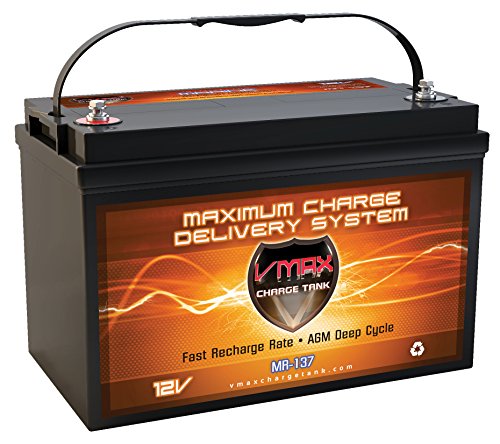
VMAX MR137-120 12V 120Ah AGM Group 31 battery
$279.96 Published specsTwenty extra amp hours in the same Group 31 case, which is free capacity if the tray already fits a 31.
Check price on Amazon
VMAX XTR27-110 12V 110Ah AGM Group 27 battery
$299.96 Published specsThe high performance VMAX line, built for deeper and more frequent cycling than the standard MR series.
Check price on AmazonFrequently asked questions
How many amp hours do I need for 40 amps over 2 hours?
About 197 Ah in AGM or 104 Ah in LiFePO4. The energy actually used is 80 Ah in both cases. The gap is the Peukert effect at that discharge rate plus the depth of discharge guideline, which on lead acid means half the nameplate was never available to begin with.
Why is the lithium figure so much smaller?
Two reasons that compound. LiFePO4 has a Peukert exponent near 1.02, so it delivers essentially its rated capacity even at a heavy draw, while AGM at 1.15 gives up a real fraction of it. And lithium is planned at eighty percent depth of discharge rather than fifty. Together those turn a 197 Ah lead acid requirement into roughly 104 Ah of lithium.
Should I size from the published maximum draw?
Only if you genuinely run the motor at full power for the whole trip, which almost nobody does. A published maximum draw is measured at maximum thrust. Sizing from it is conservative and expensive, and measuring your own average draw across a normal day with a clamp meter usually shows a figure well under half the rating.
Does adding a second battery double the run time?
In parallel at the same voltage, close to it, and slightly better than double on lead acid because the pair is discharged at a gentler rate relative to its combined capacity. In series for a higher voltage motor it does not: two 12 volt batteries wired in series make 24 volts at the same amp hours, which buys thrust rather than time.
How much does the extra capacity weigh?
That is usually the real constraint rather than the money. A 100 Ah lead acid battery runs around 60 lb and a 100 Ah LiFePO4 pack around a third of that, and on a small boat or a kayak the weight decides the answer before the price does. The exact figure is a manufacturer specification for each battery rather than a general rule.
What charger do I need for a bank this size?
Roughly ten to thirteen percent of the bank capacity per bank is the lead acid convention, so a 200 Ah bank wants somewhere around 26 amps. Lithium accepts far more and twenty percent is a comfortable onboard figure. What matters more than the amps is that a lithium pack gets a charger with a lithium profile.
Get the complete rigging shopping list
Every item in the beginner, intermediate and expert rigs for both a boat and a kayak, with running totals, in one printable list. No charge.
One list, no sequence of daily emails, and you can leave at any time.
Researched, not professional advice. This page is compiled from published engineering and regulatory figures, manufacturer specifications and owner-review consensus, not hands-on testing. Figures described as a rule of thumb are boating convention rather than published standards, and they are labelled that way wherever they appear. Marine electrical work is not house wiring. Use tinned, finely stranded marine cable, size it for voltage drop and for the ABYC E-11 ampacity table rather than one or the other, and put overcurrent protection within seven inches of the battery positive terminal, because everything between the post and the fuse is unprotected. A lithium battery needs a charger with a lithium profile. Never load a boat past its capacity plate, and remember that canoes and kayaks carry no federal capacity plate at all, so their stated capacity is the manufacturer own figure. Wear the life jacket, and treat early season water as the hazard it is: cold water immersion takes your breath and then your hands long before it takes your core.